


A Comprehensive Guide For X678 Chain
The X678 chain is a drop forged rivetless chain used as the main pulling and carrying element in overhead conveyor systems.
The design links forged components with pins instead of rivets, so the chain flexes freely in three dimensions. Buyers also know this product as the X67 trolley chain or the X678 CAT chain. All three names describe the same chain family. This guide explains how the chain is built, how it performs under load, how it compares with other conveyor chain types, where it fits, and how to plan an installation. Readers can use these facts to judge whether the design suits their conveyor layout and duty cycle.
Key Takeaways
The X678 Chain is a drop forged rivetless chain for overhead conveyors.
Its 6-inch pitch and 7/8-inch pin make it different from smaller chains.
Published catalogue data rates the standard link at 85,000 lb ultimate strength.
Forged links and hardened parts give the chain strong wear resistance, and the forged link versus welded steel chain comparison sets out where each design fits.
The chain suits long overhead runs with heavy loads.
Smaller chains suit compact layouts with tight curves.
Check track radii, load per carrier, and sprocket match before ordering.
Tension the chain evenly and inspect it on a regular schedule; why chain tension affects long-term performance explains the adjustment sequence.
What Is the X678 Chain
Definition and Purpose
Drop forged rivetless design
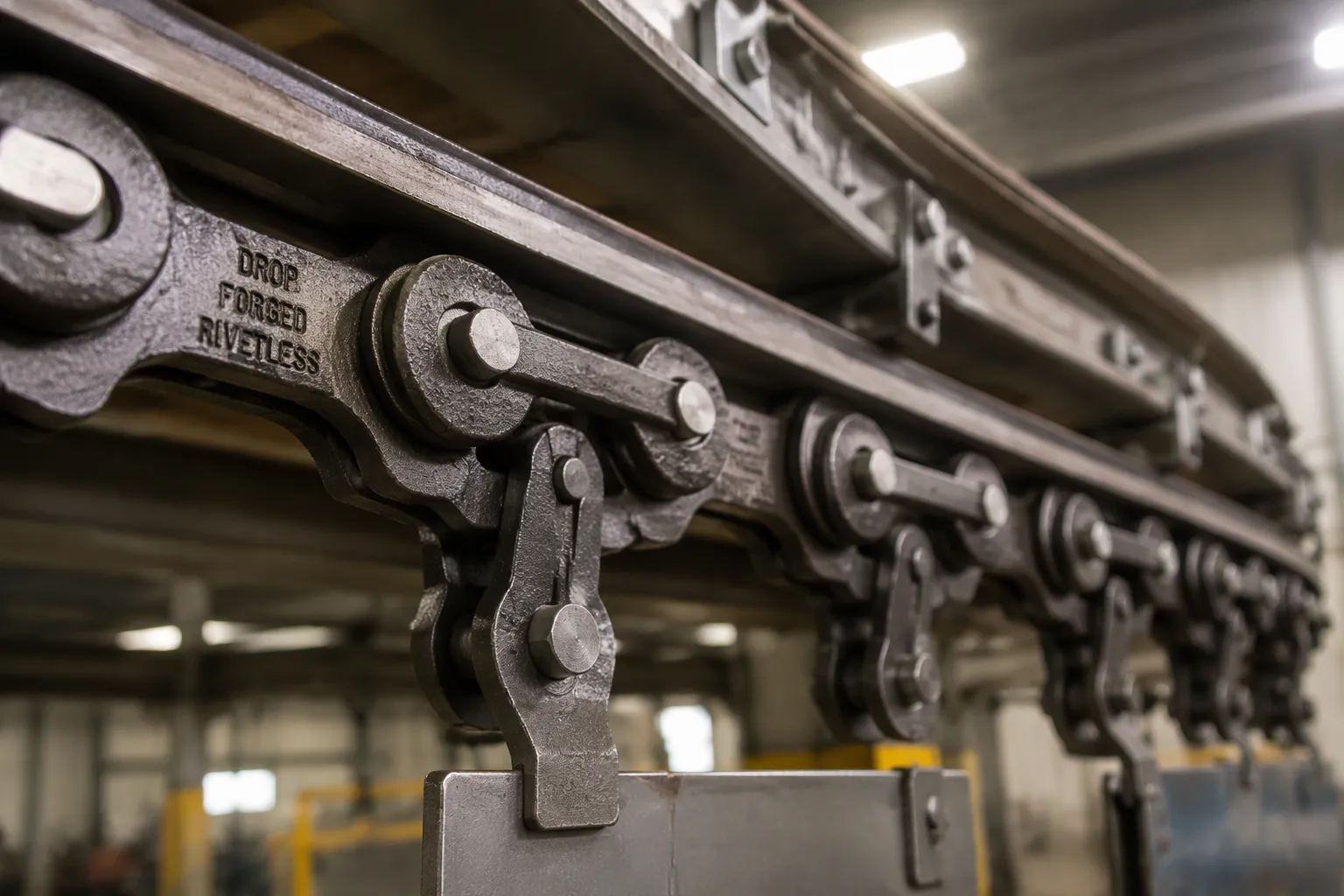
The X678 Chain is a drop forged rivetless chain. People who work with it also call it the X67 trolley chain or the X678 CAT chain. The name tells you the key sizes. The "6" means a 6-inch pitch, and the "78" means a 7/8-inch pin. Each link is forged from steel instead of being put together from stamped plates. The links join with pins, not rivets, so no rivet head holds the parts together. This rivetless setup lets the chain bend in more than one direction. It also lets workers take a run apart at any joint to repair or replace it. The full X678 chain guide covers the same structure in more detail.
Overhead conveyor role
The main job of this chain is to pull and carry loads in overhead conveyor systems. The chain runs in a track, and trolleys hang from it to move parts, components, or products along a set path. Drop forged rivetless chains are used in overhead power and free conveyors. Common industries include industrial minerals, meat processing, general manufacturing, and distribution and sortation. The same chain family also shows up in special processes, including sugar-mill drives built for high grinding loads. The drop forged rivetless chain range covers the X348, X458 and X678 sizes in one place.
X678 Chain Specifications
Pitch and pin size
Pitch and pin diameter decide how the chain fits with sprockets and trolleys. Published dimensions give the X678 pitch as 6.031 inches (153.2 mm) with a 7/8-inch pin, listed as 0.87 to 0.88 inch depending on the catalogue. These sizes do not swap with smaller or larger chain sizes. A pitch that does not match will not sit right on the sprocket teeth, and a wrong pin size will not fit the trolley brackets.
X348, X458, and X678 chains have different pitches, widths, sprockets, and track sections. They should not be mixed on a single drive run.
Strength and weight ratings
Strength ratings give buyers a starting point for sizing a system. Published catalogue data lists two grades for this chain, shown below.
| Specification | Minimum Strength |
|---|---|
| Standard | 85,000 lbs |
| High Alloy | 125,000 lbs |
Grade values differ between sources, so the figure should be confirmed on the data sheet for the exact model. Published chain catalogues list about 85,000 lb average ultimate strength for the standard X678 and about 100,000 lb for the alloy heat-treated version, while some suppliers quote 125,000 lb for their heavy-duty grade.
Buyers should treat these as typical reference numbers. The real working load depends on the trolley setup, the number of attachments, and the duty cycle of the line.
Design Advantages
Structural strength
Drop forged rivetless chain is a common choice for heavy industrial work. Forging lines up the steel grain with the shape of the link, and heat treatment comes next. Published process descriptions note that each part goes through a controlled heat treatment to give impact resistance and load capacity. A double-hinged link design raises lateral bending resistance, which helps the chain stay steady on three-dimensional conveying paths. One manufacturer reports sidebar thickness increased by about 15 percent compared with conventional industrial conveyor chain, which lowers the risk of deformation under high load.
Wear and service life
Wear control starts at the contact points. One supplier reports rollers carburized and hardened above HRC60, paired with nickel-plated pins. That combination cuts friction and slows material loss at the joints. High-precision forged dimensions also let parts move smoothly against each other, and published product descriptions credit this fit with reduced friction and longer service life. The practical result is fewer replacements and less unplanned downtime on a busy line.
Two forged bodies from the same production family are shown below; both rely on the grain flow and heat treatment described above.
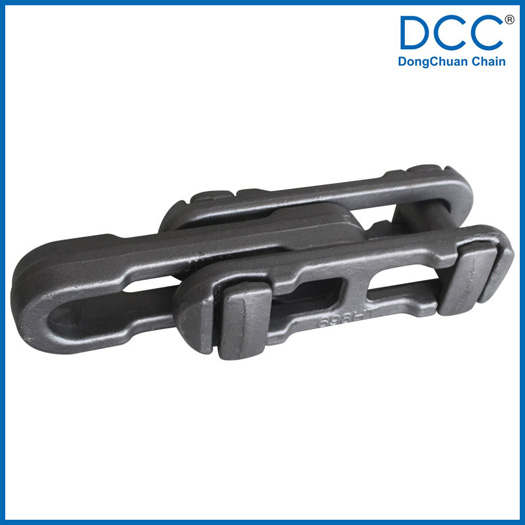
X348, X458 and X678 Drop Forged Chain
Rivetless chain family with forged links and pins, sold in three pitches for I-beam and power-and-free track.
View Product
Forged Fork Link Chain
Forged link chain built with fork-shaped sidebars for high-temperature and heavy-duty conveying duty.
View ProductHow the X678 Chain Performs
Load and Durability
High-strength construction
The forged link and pin design is what gives the chain its load capacity. Each link carries force through a solid steel body instead of stamped plates. This build supports the standard 85,000 lb and high alloy 125,000 lb ratings noted earlier. A 6-inch I-beam conveyor system built around X678 chain is listed at up to 9,600 lb capacity in a used-equipment listing, which shows the order of load a real overhead layout can carry.
Heavy loads also need stable joints. The double-hinged link design resists lateral bending, so the chain holds its line when trolleys pull sideways. Carburized rollers and nickel-plated pins cut friction at the contact points. These features work together to keep the chain moving under steady load.
Performance in tough environments
Industrial settings expose chain to heat, grit, and moisture. The forged and heat-treated links resist impact and wear in these conditions. The chain is built to serve demanding conveyor systems where unplanned downtime carries a high cost, and it delivers the strength and flexibility needed to keep production moving in challenging industrial environments.
Lubrication choice matters in harsh settings. High-temperature curing ovens need synthetic lubricants that resist oxidation and evaporation. Sites with high airborne particulates do better with dry film lubricants containing graphite or MoS2. Matching the lubricant to the environment protects the pin and bushing joint.
Efficiency and Reliability
Smooth travel through track curves
Roller turns guide the chain and trolleys through horizontal track curves. Each bearing sits centered vertically on the chain centerline. This alignment keeps the load balanced as the chain rounds a bend. Smooth movement through curves reduces jerking and supports reliable travel along the full track path.
Low maintenance operation
A planned maintenance schedule keeps the chain running. One published maintenance outline for high-load systems is shown below, and the conveyor chain adjustment and inspection schedule explains how each interval is carried out.
| Maintenance Requirement | Interval / Specification |
|---|---|
| Nozzle alignment audits | Weekly |
| Tension audits at take-up unit | Monthly |
| Deep cleaning for lubricant buildup | Quarterly |
| Chain elongation limit | Above 2-3% of original pitch needs immediate replacement |
In this outline, the nozzle audits refer to the lubrication nozzles on an automatic system, not to the cutting torch sense of the word. Automatic lubrication systems with sensors deliver precise volumes to the pin-bushing joint. Infrared thermography and vibration analysis on gear reducers and motor bearings support predictive maintenance.
Application Fit
Industries that fit the chain
Common sectors for this chain include:
Overhead conveyors
Automotive assembly lines
Car washes
Finishing systems
Meat processing
Sugar refining
Heavy material handling
These settings share a need for steady pulling power and tolerance for continuous duty.
Where it fits less well
The 6-inch pitch and heavy link weight suit long overhead runs, not compact layouts. Short, tight conveyor paths with small sprockets call for a smaller chain size. Light-duty lines that carry small loads gain little from the chain's strength. Buyers should match chain size to track geometry and load before selecting this model.
Matching a Chain to Your Track Layout?
Send the track drawing, load per carrier and duty cycle to confirm which pitch, grade and sprocket set apply.
X678 Chain vs. Other Chains
Performance Comparison
Strengths of the rivetless design
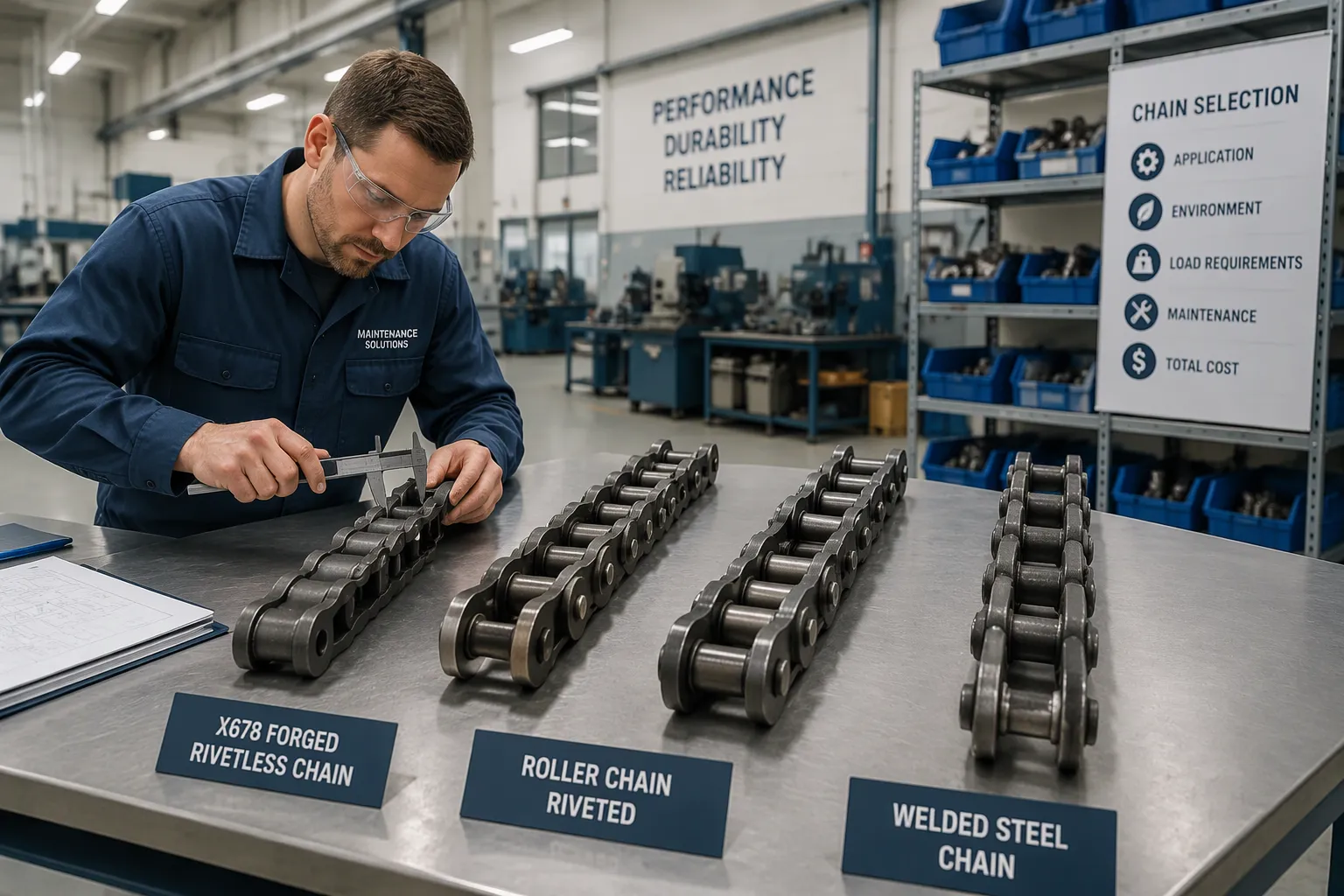
Drop forged rivetless chain is a good choice because it is both strong and easy to fix. How to choose a drop forged chain for an application sets out the load and heat questions that decide the grade. The X-348, X-458, and X-678 series use continuous grain flow from precision forging of SAE 4140 or 1045 steel. That grain flow gives a better strength-to-weight ratio than cast or machined options, and it directly affects drive motor energy use and system mean time between failures. The three-part interlocking design, made of a center link, side link, and pin, allows tool-free assembly. A technician can loosen the tension and swap a part quickly, which shortens mean time to repair on continuous automotive and industrial paint lines. Induction-hardened or carburized surfaces strike a Rockwell hardness balance. The surface resists wear while the core stays ductile, so the link bends under impact instead of cracking. Engineered clearances at the pin-to-link interface let the chain side-flex and climb steep inclines without binding, which keeps lateral stress off tracks and trolleys.
Trade-offs to weigh
Each chain type has its own compromises. Roller chains run well on short, tight layouts with small sprockets, yet their riveted construction slows field repair. Welded steel chains handle abrasive bulk duty, but they offer less flexibility on three-dimensional paths. The X678 chain family overview covers the long-run duty case in more detail, and one conveyor builder lists a working range of 500–2,500 lb per carrier. A buyer trading up to this size gains capacity and repairability, and accepts a heavier link and a larger track envelope in return.
Application and Compliance Fit
Where each option fits
Fit depends on the conveyor architecture, not on a ranking. The same X348, X458, and X678 forged rivetless families serve both monorail and power-and-free systems, with identical chain metallurgy, pin diameter, side-bar geometry, and cotter-pin retention. The difference sits in the trolleys and controls. A monorail needs one part-time mechanic to maintain 1,000 ft or more, with chain lubrication every 2–4 weeks and wheel inspection quarterly. Power-and-free systems add free trolley cam followers that wear faster from stop-start impact, pneumatic stop seals that need replacement every 12–24 months, and pusher dog cam followers that wear through the lift-slide-drop cycle. Roller chain layouts fit compact cells and light transfer lines. Welded steel chain fits harsh bulk conveying where abrasion dominates.
Compliance considerations
In the United States, overhead conveyors are guarded under the general machine guarding requirements and designed to the safety standard for conveyors and related equipment. The rules shape the system around the chain:
Guarding for overhead runs requires wire mesh headers or sideboards that withstand falling-load impact wherever tracks cross work areas or thoroughfares.
Mechanical anti-runback devices, or safety dogs, are required on inclined and declined sections to stop gravitational acceleration after a drive failure or chain breakage.
Emergency stops must sit within easy reach, carry clear markings, and require a manual reset before re-energizing.
All nip points where chain meets sprockets need shielding, in line with the guarding rules for mechanical power-transmission apparatus, and enclosed track designs must protect workers from moving internal parts.
These requirements apply to the conveyor as a whole, so they shape the choice of chain, track, and drive together.
Cost Comparison
Upfront and lifecycle costs
Purchase price and running cost tell different stories. One conveyor builder gives installed cost per linear foot for common layouts:
| Layout | Installed Cost per Linear Foot |
|---|---|
| I-beam monorail | US$45–$75 |
| Enclosed track monorail | US$55–$95 |
| X458 power-and-free | US$95–$140 |
| Heavy X678 power-and-free | US$140–$220 |
Lifecycle cost shifts the picture. In one published comparison, power-and-free maintenance runs 2.5–3.5 times the cost per foot per year of a monorail on the same duty cycle. Chain replacement typically falls every 5–8 years depending on cycles. A 3% elongation limit is a common replacement point that protects drive sprockets and system timing, and automatic lubrication of pin-bearing surfaces extends the interval.
Value positioning
Value depends on duty. A monorail on steady duty delivers low maintenance per foot. A power-and-free line justifies its higher cost through routing flexibility and buffer capacity. The forged rivetless design pays back through fast repair and predictable wear. Buyers should weigh installed cost against maintenance hours, downtime risk, and the number of carriers the line must move.
Use Cases for the X678 Chain
Common Deployment Scenarios
Overhead conveyor systems
The X678 drop forged chain works in overhead conveyor systems in many industries. Common uses include automotive paint and body shops, powder-coating job shops, E-coat dip lines, appliance manufacturing, and foundry casting transfer. Food-grade stainless versions also handle meat and poultry processing. All these settings need steady pulling power along long runs.
Track layout shapes how the chain is used. Five standard layouts are common: a single continuous loop, an inline straight run, an over-under stacked pair, a spur with branch lines, and a power-and-free network with switches. The dual-track power-and-free design lets single carriers stop, pile up, or switch onto sidings while the main chain keeps running. Automotive body shops and asynchronous assembly lines depend on this buffer capacity.
Material handling lines
Load capacity changes by track type. One conveyor builder reports that a 6-inch I-beam with X678 chain handles up to 2,500 lb per carrier, while power-and-free carriers handle 250–1,500 lb. Twin-trolley assemblies double single-trolley ratings. The table below compares the X678 against smaller siblings in the same family.
| Chain | Pitch | Working Load | Ultimate Strength | Compatible Track |
|---|---|---|---|---|
| X348 | 3″ | 2,000 lb | 17,000 lb | 3″ I-beam, 3″ enclosed track |
| X458 | 4″ | 4,000 lb | 36,000 lb | 4″ I-beam, 4″ enclosed track, P&F |
| X678 | 6″ | 8,000 lb | 72,000 lb | 6″ I-beam, heavy P&F |
This table reflects one supplier's comparison. Other published catalogues give higher ultimate strengths for the same three sizes, at roughly 24,000 lb for X348, 48,000 lb for X458 and 85,000 lb for X678, with a maximum working load near 7,100 lb for X678. Size a drive from the current data sheet rather than from a single table.
Curve radii also depend on chain pitch. One builder's layout rules set a 60-inch minimum horizontal radius for X678, with vertical curves at least 1.5 times that radius, or 90 inches. Other system builders quote a 180-inch centreline radius as the common vertical curve, so the track drawing governs the final figure.
Expected Outcomes
Reliability and service life
Precise pitch control supports consistent, reliable operation. Smooth forged bearing areas allow longer wear life, and a special heat treatment gives a balance of strength, toughness, and durability. An ultra wear life version uses an induction-hardened pin for better wear resistance. These features support long service intervals on demanding lines.
Maintenance savings
Tool-free assembly shortens repair time. A technician can loosen tension and swap a link without special tools, which cuts downtime on continuous-duty lines. Planned lubrication and tension audits further extend the replacement interval. Buyers should treat these as expected benefits rather than assured results, since actual life depends on load, duty cycle, and environment.
Configuration Selection
Matching chain to application
Track geometry drives the choice. Long overhead runs with heavy carriers suit the 6-inch pitch and 6-inch I-beam track. Compact cells with small sprockets need a smaller size. Power-and-free layouts justify the X678 where indexing or buffer accumulation matters.
Pre-selection questions
Buyers should confirm the load per carrier, the track type, and the required curve radii before ordering. They should also check the duty cycle and the available maintenance window. Answers to these questions narrow the choice quickly and prevent a mismatch between chain size and conveyor layout.
Need a Chain and Sprocket Set That Match?
Describe the track type, carrier load and duty cycle to get a chain, sprocket and take-up specification that fits the layout.
Implementing the X678 Chain
Planning and Setup
Preparation steps
A good installation begins with a site review. The team checks the track layout, curve radii, and load per carrier before the chain arrives. They also make sure matching sprockets are ready, because the chain and sprocket must work as one drive solution. A sprocket that does not match wears both parts out faster.
Next, the team checks the take-up unit and frame alignment. Installation guidance recommends using a straightedge or laser to check sprocket parallelism. Workers should also confirm that all fasteners meet torque specs before tensioning starts.
Installation guidance
Installers thread the X678 Chain through the track and make sure the pins sit fully in each link. Then they apply initial tension at the take-up unit and balance the adjustment on both sides. Unequal bolt adjustment is a common reason a chain runs to one side.
New chain needs a break-in period. Plan for adjustment after 4-8 hours of first operation, again at 24 hours, then weekly for the first month, following the chain adjustment guide.
Operation and Maintenance
Routine operation tips
Daily care protects the chain and the product it carries. Published food-industry guidance recommends removing residues, fat, and moisture from chains, trolleys, and load bars, then disinfecting with food-grade detergents. Regular lubrication with food-grade lubricant lowers friction and stops rust.
Watching the chain matters as much as cleaning it. Track chain tension, speed, and load to catch problems early. The same maintenance outline calls for monthly tension audits at the take-up unit and infrared thermography on gear reducers and motor bearings.
Troubleshooting basics
Common faults have known causes. The table below sums up published troubleshooting guidance.
| Problem | Likely Causes | Solutions |
|---|---|---|
| Chain runs to one side | Unequal take-up adjustment; sprocket misalignment | Equalize both sides; check sprocket parallelism |
| Tension will not hold | Worn take-up device; loose fasteners; poor lubrication | Inspect the device; torque bolts; improve lubrication |
| Tight and loose spots | Uneven elongation; damaged links | Measure sag at several points; replace worn links |
Elongation above 2–3% of original pitch means critical wear and needs immediate replacement.
Sourcing and Support
Supplier evaluation criteria
A good supplier offers precision manufacturing and quality materials. Buyers should ask about forging and heat treatment control, pin and roller hardness, and whether the supplier stocks matching sprockets. Quick technical support and clear lead times also matter.
Manufacturer reliability
Reliable makers stand behind steady tolerances and steady supply. Manufacturer and model information sets out the production scope, quality certificates and model range to check before ordering, including whether chain and sprockets come from one source as a complete drive solution.
The X678 Chain is a drop forged rivetless chain for overhead conveyors. Its 6-inch pitch and 7/8-inch pin set it apart from smaller sizes. Published catalogue data rates standard links at 85,000 lb ultimate strength. Forged links, hardened rollers, and plated pins support steady duty. The design suits long runs and heavy carriers. Compact layouts do better with a smaller chain. Planning pays off. Check track radii, load per carrier, and sprocket match before ordering. Then tension the chain evenly and inspect it on a set schedule.
Planning a New Overhead Conveyor Line?
Share the layout, carrier load and duty cycle to line up chain pitch, sprockets and take-up travel in one specification.
FAQ
What do the numbers in the X678 name mean?
The name encodes the two key dimensions. The "6" stands for a 6-inch pitch, and the "78" stands for a 7/8-inch pin diameter. These sizes set the chain apart from smaller family members such as the X348 chain and the X458.
Which strength grade should a buyer choose?
The drop forged chain selection guide sets out two grades. The standard grade is rated at 85,000 lb minimum strength and the high alloy grade at 125,000 lb. Buyers pick the grade that matches their load per carrier and duty cycle. Heavier carriers and continuous duty favour the high alloy option, and the exact figure should be confirmed on the data sheet for the model ordered.
How much does the chain weigh?
Published catalogue data puts the X678 at roughly 6.7 lb per foot. Buyers should confirm the chain weight with the supplier for their specific attachment configuration and link count, since it affects track support, take-up capacity, and handling equipment planning.
What curve radii does the chain require?
Track geometry must respect the chain pitch. One builder's layout rules call for a 60-inch minimum horizontal radius for X678 and a vertical radius at least 1.5 times that figure, while other builders quote a 180-inch centreline radius as a common vertical curve. Tighter curves call for a smaller chain size, so designers should confirm radii against the track drawing before finalizing the layout.
Does the chain need matching sprockets?
Yes. The chain and sprocket work as one drive solution. A sprocket that does not match the pitch and pin size wears both parts faster. Buyers should order sprockets from the same source as the chain to keep tolerances aligned.
How often should a team adjust a new chain?
New chain stretches during break-in. Plan an adjustment after 4–8 hours of first operation, again at 24 hours, then weekly for the first month. After break-in, monthly tension audits at the take-up unit keep the run stable.
When does the chain need replacement?
Measure elongation against the original pitch. Wear above 2–3% of original pitch means critical wear and calls for immediate replacement. Replacing at that limit protects the drive sprockets and keeps system timing accurate.
Can a technician repair the chain in the field?
Yes. The rivetless design allows tool-free assembly. A technician loosens the tension and swaps a link or pin without special tools. This shortens repair time on continuous-duty lines and reduces unplanned downtime.
Next reading: Key Factors to Check When Selecting Industrial Conveyor Chains in 2026
References and Notes
General requirements for all machines — machine guarding duties that cover conveyor guarding (osha.gov, accessed 2026-11-09)
Safety standard for conveyors and related equipment — design, guarding and emergency-stop requirements for conveyors (asme.org, accessed 2026-11-09)
Guarding rules for mechanical power-transmission apparatus — sprocket, chain and nip-point guarding (osha.gov, accessed 2026-11-09)
Data notes: published chain catalogues give the X678 an average ultimate strength of about 85,000 lb for the standard grade and about 100,000 lb for the alloy heat-treated grade, with a maximum working load near 7,100 lb; the 125,000 lb and 72,000 lb figures in the tables are supplier-stated values, so confirm the grade on the data sheet. The 2,500 lb and 9,600 lb loads are system or per-carrier figures from conveyor builders, not chain ratings. Installed costs, the 5–8 year replacement interval and the 2.5–3.5 times maintenance ratio are single-source estimates. Curve radii come from one builder's layout rules and vary with trolley spacing. The 15 percent sidebar thickness increase and the HRC60 roller hardness are manufacturer-stated figures.
Internal links: all original links to dcchains.com are preserved, with anchor text rewritten to describe the destination page.

