


A Complete Guide to Apron Conveyor Chain Applications Across Industries
Apron Conveyor Chain is one of the most versatile and durable material handling solutions available for heavy industrial environments. By combining overlapping steel plates with high-strength chain links, the system creates a continuous, robust surface capable of transporting sharp, abrasive, hot, or irregularly shaped materials that would destroy conventional rubber belt conveyors within weeks. From ore processing in mining operations to castings transport in foundries, from clinker handling in cement plants to component delivery on automotive assembly lines, apron conveyor chains are a critical element in keeping industrial operations running safely and efficiently. The global apron conveyor market has been growing steadily, driven by rising automation investment and the demand for more reliable bulk material handling across heavy industry sectors.
Apron conveyor chains use overlapping steel plates connected by heavy-duty chain links to move materials that conventional belt conveyors cannot handle safely.
Heat resistance up to 600°C makes them indispensable in foundry, metallurgy, and cement applications.
The fully enclosed, leak-proof structure prevents material loss and keeps work areas clean during high-volume operations.
Material selection — carbon steel, alloy steel, or manganese steel — must match the specific abrasion, temperature, and load conditions of the application.
Regular re-lubrication (every 8 hours under continuous operation), monthly visual checks, and scheduled diaphragm inspection are the three pillars of effective chain maintenance.
Changzhou DONGCHUAN holds ISO9001 and API certifications and offers custom engineering, OEM, and ODM support for project-specific chain requirements.
What Is an Apron Conveyor Chain
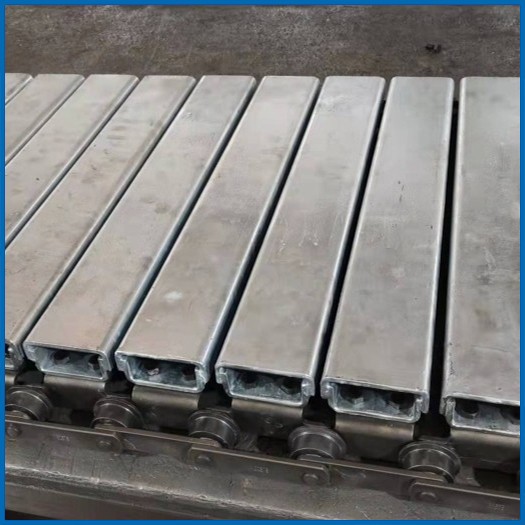
The overlapping plate structure of an apron conveyor chain creates a continuous, leak-proof surface that moves bulk materials without spillage or jamming.
An apron conveyor chain is a specialized heavy-duty conveying system consisting of overlapping steel plates — called pans or flights — mounted on two parallel roller chains. As the chains move, the steel plates form a continuous rigid surface that carries bulk materials from one point to another. Unlike belt conveyors, there are no elastomers to degrade under heat or impact, which is precisely why industries handling hot castings, sharp ore, or chemically aggressive materials rely on this design.
The chain conforms to the dimensional and performance requirements defined in international standards for industrial conveyor chains. ISO 1977:2006[1] specifies the characteristics of conveyor chains including dimensions, interchangeability, and sprocket engagement criteria — providing the engineering framework that ensures conformant chains deliver reliable performance across global applications.
Core Components and Materials
| Component | Material | Function |
|---|---|---|
| Chain Links | Carbon steel, alloy steel, or manganese steel | Provide tensile strength and impact resistance under heavy loads |
| Steel Plates (Pans) | High-strength structural steel | Form the carrying surface; overlap to prevent material leakage |
| Connecting Pins & Bushings | Heat-treated steel | Reduce friction and wear between articulating links; maintain alignment |
| Surface Coatings | Galvanization, powder coat, or hard chrome plating | Protect against corrosion and abrasive wear |
How the System Works
Drive sprockets at the head end engage the chain links and pull the plate assembly forward at a consistent speed. The overlapping plates carry material along the conveyor's length and discharge it at the head end. Unlike apron feeders (which control feed rate at low speed), apron conveyors typically operate at a fixed, relatively high speed to maintain throughput. The return side of the chain travels below the carrying surface, supported by return rollers, before re-engaging the tail sprocket and beginning another cycle.
Design and Performance Advantages
Overlapping Steel Plate Structure
The overlapping plate geometry is the design feature that makes apron conveyor chains suitable for materials that would immediately damage or destroy belt systems. Each plate overlaps the next in the direction of travel, eliminating gaps through which material could fall. The plates interlock in a way that accommodates the articulation required as the chain travels around the head and tail sprockets, while maintaining a continuous carrying surface along the straight run. High-strength steel construction gives the plates resistance to impact, indentation, and abrasive surface wear from sharp ore, rock, and metal scrap.
Heat and Impact Resistance
Steel plate apron conveyors can operate continuously in environments reaching up to 600°C — a threshold no rubber or polymer belt can approach. This thermal capability is the reason foundries use apron conveyors to transport hot castings directly from the shakeout station, and why cement plants rely on them for clinker discharge from rotary kilns. The steel plate construction also absorbs the kind of impact loading generated by large rock fragments or metal billets dropped from hoppers — impact that would tear or splice a belt within hours of operation.
Leak-Proof Structure and High Load Capacity
The fully enclosed plate structure prevents dust and fine material from escaping through the conveyor, which matters both for material efficiency and for workplace air quality compliance. High-volume operations — conveying hundreds of cubic metres per hour — depend on this containment performance to avoid constant cleanup and material loss. The waterproof and dust-resistant design also protects the chain mechanism from contamination by fine abrasive particles that would accelerate pin and bushing wear.
Industry Applications
Mining & Quarrying
Moves large rocks, ores, and minerals from extraction points to crushers or stockpiles. The overlapping plates protect the chain from the sharp, abrasive surfaces of run-of-mine material. Apron feeders in this sector control material flow rate to prevent crusher blockages and protect downstream equipment.
Foundry & Metallurgy
Transports hot castings, metal scrap, and sand from shakeout stations and furnace areas. The 600°C heat resistance is essential here — no rubber belt can enter this environment. Apron chains also handle loose materials like molding sand that would penetrate and damage belt conveyors.
Cement & Bulk Materials
The cement industry accounted for 22% of global apron feeder demand in 2025, driven by clinker discharge from kilns and limestone handling in raw material preparation. Abrasion resistance and thermal stability are the defining requirements in this sector.
Recycling & Solid Waste
Handles metal scrap, glass, and mixed waste streams where unpredictable sharp objects and irregular load distribution make belt conveyors unreliable. The leak-proof structure prevents fine material from contaminating the work area below the conveyor.
Automotive & Manufacturing
Transports heavy components — engine blocks, assembled sub-assemblies — along production lines. Integration with robotic welding stations and automated assembly systems benefits from the consistent, predictable delivery that apron conveyors provide at fixed speed.
Food Processing
Food-grade apron conveyor designs use compliant materials (PU, PVC, food-grade rubber) and feature tension-release mechanisms for cleaning access. FDA and EU regulatory compliance governs material selection and surface finish specifications in this sector.
Global demand distribution by sector reflects the concentration of heavy industry users:
| Industry Sector | Share of Global Apron Feeder Demand (2025) |
|---|---|
| Cement | 22% |
| Metallurgy | 19% |
| Construction Materials | 11% |
| Mining & Quarrying | Other major share |
| Other Sectors | Remainder |
How to Choose the Right Apron Conveyor Chain
Load and Material Considerations
Material type and bulk density determine the required chain strength and plate geometry. Manganese steel links are preferred for high-abrasion materials such as quarried rock or ore. Stainless steel is selected for corrosive environments or hygienic applications. The conveyor must be matched to the feeder or hopper design — a mismatch in chain pitch, pan width, or load capacity leads to misalignment, accelerated wear, and eventual premature failure.
| Selection Criterion | Guidance |
|---|---|
| Bulk Density | Denser materials require heavier chain construction and more robust plate thickness |
| Abrasiveness | Highly abrasive materials demand manganese steel or heat-treated alloy steel components |
| Maximum Lump Size | Pan width and plate overlap must exceed the maximum expected lump dimension to prevent jamming |
| Moisture Content | Wet or sticky materials can cause buildup on return rollers and sprockets — design must account for self-cleaning |
| Temperature | Elevated operating temperatures require heat-treated steel; polymer components are excluded above approximately 150°C |
Temperature and Environmental Factors
Operating temperature directly determines whether standard carbon steel or heat-treated alloy steel is required for both chain and plate components. Dust, moisture, and chemical exposure influence the choice of surface treatment — galvanized finishes protect against corrosion in wet environments, while hard chrome plating extends wear life in abrasive dusty conditions. For outdoor installations, UV and weathering resistance should be factored into material and coating selection.
System Compatibility and Customization
Apron conveyor chains must be dimensionally compatible with the drive and tail sprockets, return roller spacing, and frame geometry of the existing conveyor structure. Where the conveyor is being designed from scratch, customization of chain pitch, pan width, link style, and surface treatment provides the flexibility to optimize the system for the specific application. DONGCHUAN offers custom engineering under OEM and ODM arrangements, with products certified to ANSI, DIN, and ISO standards — the international benchmarks governing conveyor chain interchangeability and performance, as catalogued in the ANSI conveyor standards framework[2].
| Customization Parameter | Available Options |
|---|---|
| Chain Material | Carbon steel, alloy steel, manganese steel, stainless steel |
| Pan / Plate Width | Customized to conveyor frame width |
| Link Style | Standard and non-standard configurations |
| Surface Treatment | Heat treatment, galvanization, hard chrome plating, powder coat |
| Certification Standard | ANSI, DIN, ISO |
| OEM / ODM Support | Available — engineering assessment and load calculation included |
Maintenance and Optimization
Routine Inspection and Cleaning
A structured inspection schedule prevents the accumulation of small issues into costly failures. Under continuous heavy-duty operation, re-lubrication should occur every 8 hours. Daily and weekly checks focus on debris accumulation, lubrication status, and chain alignment. Monthly audits involve full visual examination of all plates, pins, and sprocket teeth. Annual reviews include detailed elongation measurement — the primary indicator of pin and bushing wear — and lubrication system flush and refill.
| Maintenance Activity | Frequency | Focus |
|---|---|---|
| Re-lubrication | Every 8 hours (continuous duty) | Pin, bushing, and roller contact surfaces |
| Operational check | Daily / Weekly | Debris, misalignment, unusual noise or vibration |
| Visual audit | Monthly | Plate condition, sprocket wear, chain sag |
| Elongation measurement | Annually | Pin-to-pin pitch compared to new chain specification |
Lubrication and Wear Management
Correct lubricant selection is as important as lubricant application frequency. Oil lubrication is preferred in high-speed or high-temperature environments because it penetrates joint clearances more effectively than grease. For low-speed, medium-temperature applications, grease provides longer-lasting film protection and is less prone to displacement by gravity or centrifugal force. In food processing applications, only food-grade lubricants approved for incidental contact (H1 classification) may be used on any component that could come into contact with the product.
Troubleshooting Common Issues
Most operational problems with apron conveyor chains trace back to one of four root causes: inadequate lubrication, material spillage onto the return run, incorrect loading geometry, or mismatched chain and sprocket specification. The table below maps symptoms to probable causes and corrective actions:
| Symptom | Probable Cause | Corrective Action |
|---|---|---|
| Accelerated pin and bushing wear | Inadequate lubrication or abrasive contamination of lubricant | Increase re-lubrication frequency; install sealed-joint chain; add labyrinth seals to contain lubricant |
| Material grinding between chain and return rollers | Material spillage onto return run | Improve skirt-board sealing at loading point; install cleaners on return side |
| Chain skip on sprocket | Chain elongation exceeding sprocket tooth pitch tolerance | Measure elongation; replace chain if beyond 3% elongation limit |
| Plate misalignment or lateral drift | Uneven loading, worn guide rails, or misaligned tail sprocket | Re-center loading chute; adjust guide rail clearance; realign tail shaft |
| Excessive noise or vibration | Worn sprocket teeth, insufficient chain tension, or debris in chain path | Inspect and replace sprocket; adjust take-up; clean chain path |
Maximizing Service Life
The factors that most directly extend apron conveyor chain service life are: correct material specification for the application, a consistent and documented lubrication program, controlled loading geometry (centered loading, appropriate drop height), and timely replacement of worn components before secondary damage propagates. In humid environments, galvanized steel or stainless steel should be specified even if the primary material specification would otherwise permit carbon steel — the cost of corrosion-related premature replacement exceeds the material cost difference many times over.
Request a Quote from Changzhou DONGCHUAN
DONGCHUAN manufactures ISO9001 and API certified apron conveyor chains for mining, foundry, cement, recycling, automotive, and food processing applications. Custom engineering, OEM, and ODM support available. Heat-resistant, abrasion-resistant, and food-grade configurations in stock.
Why Choose Changzhou DONGCHUAN
Certified Quality and Engineering Capability
Changzhou DONGCHUAN holds ISO9001 and API certifications, reflecting a manufacturing process built around documented quality management and consistent product performance. Every apron conveyor chain undergoes dimensional inspection and performance testing before dispatch. The company's engineering team conducts application assessments and load calculations for complex or non-standard projects, ensuring that the specified chain is correctly matched to the customer's equipment and operating conditions.
Custom Engineering and Industry Support
DONGCHUAN's custom engineering capability covers the full range of apron conveyor chain requirements — from selecting the right steel grade and surface treatment for a specific environment, to reverse-engineering chains for legacy equipment where the original specification is no longer available. The table below illustrates how this support delivers value across different end-use sectors:
| Industry | Custom Engineering Benefit |
|---|---|
| Sugar Manufacturing | Chains tailored to the specific pitch and attachment geometry of sugar mill equipment, including corrosion-resistant specifications for wet environments |
| Palm Oil Processing | Custom chain size and material selection to handle the combination of heat, moisture, and abrasive fibrous material in palm oil mills |
| Steel Production | Reverse engineering from worn sample chains to match unique machinery requirements without access to original OEM drawings |
| Cement & Mining | Heat-treated alloy steel specifications for extreme abrasion and temperature conditions in clinker and ore handling |
Frequently Asked Questions
What materials can apron conveyor chains transport?
Apron conveyor chains handle the full range of bulk industrial materials: rocks, ores, minerals, hot castings, metal scrap, sand, clinker, limestone, glass, and assembled manufacturing components. They are specifically designed for materials that are too heavy, hot, sharp, or abrasive for rubber or polymer belt conveyors.
What temperature can apron conveyor chains withstand?
Steel plate apron conveyor chains can handle continuous operating temperatures up to 600°C. This makes them the standard choice for foundry shakeout conveyors, cement kiln clinker discharge, and metallurgical furnace output applications where no rubber or synthetic belt could survive.
How often should I maintain my apron conveyor chain?
Under continuous heavy-duty operation, re-lubricate every 8 hours. Perform daily or weekly operational checks (debris, alignment, lubrication status), monthly full visual audits, and annual elongation measurements. Increase all frequencies when operating in high-temperature or high-abrasion conditions.
How do I know when the chain needs to be replaced?
The primary wear indicator is chain elongation. Measure the actual pitch between pins across a 10-link section and compare to the nominal specification. Replace the chain when elongation exceeds approximately 3% of the nominal pitch length. Secondary indicators include visible plate cracking, sprocket skipping, or increasing vibration despite correct tension adjustment.
What certifications should I look for when purchasing an apron conveyor chain?
Look for ISO9001 certification of the manufacturing facility (quality management system), dimensional conformance to ISO 1977, ANSI, or DIN standards as applicable to your market, and where API certification is relevant to your sector. Chain suppliers should be able to provide test certificates for material composition and mechanical properties on request.
References
International Organization for Standardization. ISO 1977:2006 — Conveyor chains, attachments and sprockets. Geneva: ISO, 2006 (confirmed 2021). Available at: iso.org/standard/43971.html
American National Standards Institute (ANSI). Conveyors and Continuous Material Handling Standards — Conveyor Chain Standards. ANSI Webstore. Available at: webstore.ansi.org/industry/conveyors

