


304 vs 316 Stainless Steel Conveyor Chains Which Is Right for You
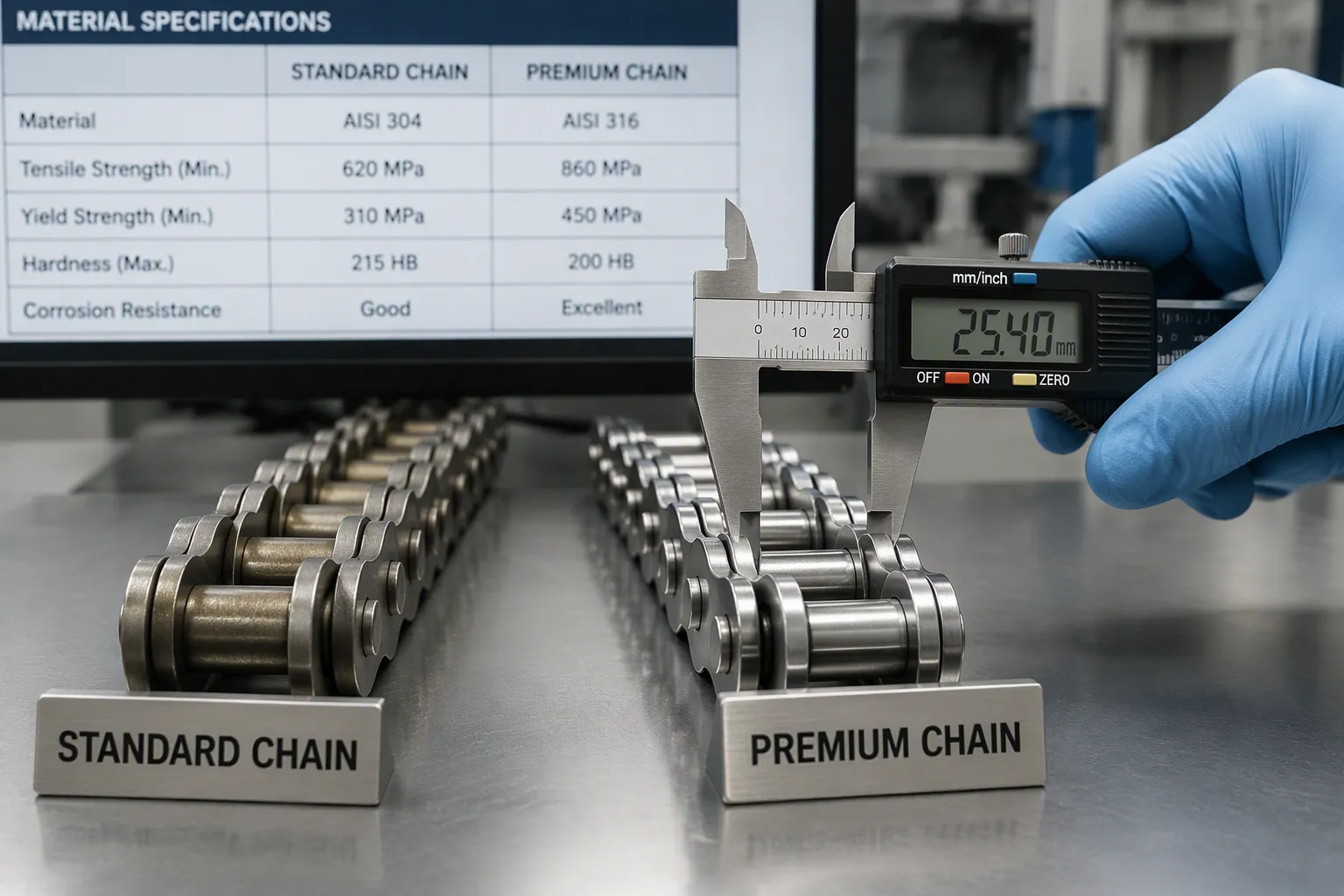
Grade 304 and grade 316 conveyor chain look alike on the shelf; chloride exposure, not the catalogue, separates them. Values in the panel above reflect one supplier’s chain-grade stock, while the annealed strip values used in this article follow ASTM A240.
The right stainless steel conveyor chain depends on where it runs. Grade 304 handles general-purpose conditions well. Grade 316 suits harsh, corrosive, or tightly regulated settings. That single distinction answers most of the 304 vs 316 question before a buyer compares catalogs.
Corrosion exposure usually decides the grade first. Strength, temperature tolerance, compliance demands, and cost then refine the choice. Cost deserves early attention: 316 stock typically runs roughly 20–40% above 304, driven by its molybdenum content and higher nickel level. The gap moves with nickel and molybdenum prices, so it is worth checking against current mill quotes rather than a fixed percentage.
A conveyor line in a dry warehouse rarely needs the premium grade. A washdown plant or chemical environment often does. Matching the grade to actual exposure is the surest path to the right stainless steel choice.
Key Takeaways
Choose 304 for dry, general-purpose lines to save money.
Choose 316 for harsh, corrosive, or washdown environments.
Check chloride exposure first: 304 begins to pit at chloride levels around 200 ppm.
316 costs roughly 20–40% more upfront but lasts longer in aggressive conditions.
Both grades share similar strength and similar temperature limits.
Match the grade to the facility's cleaning chemicals and hygiene rules.
Use a salt water immersion test to compare grades before buying.
Avoid over-specifying: 304 serves many routine conveying jobs.
304 vs 316 Stainless Steel at a Glance
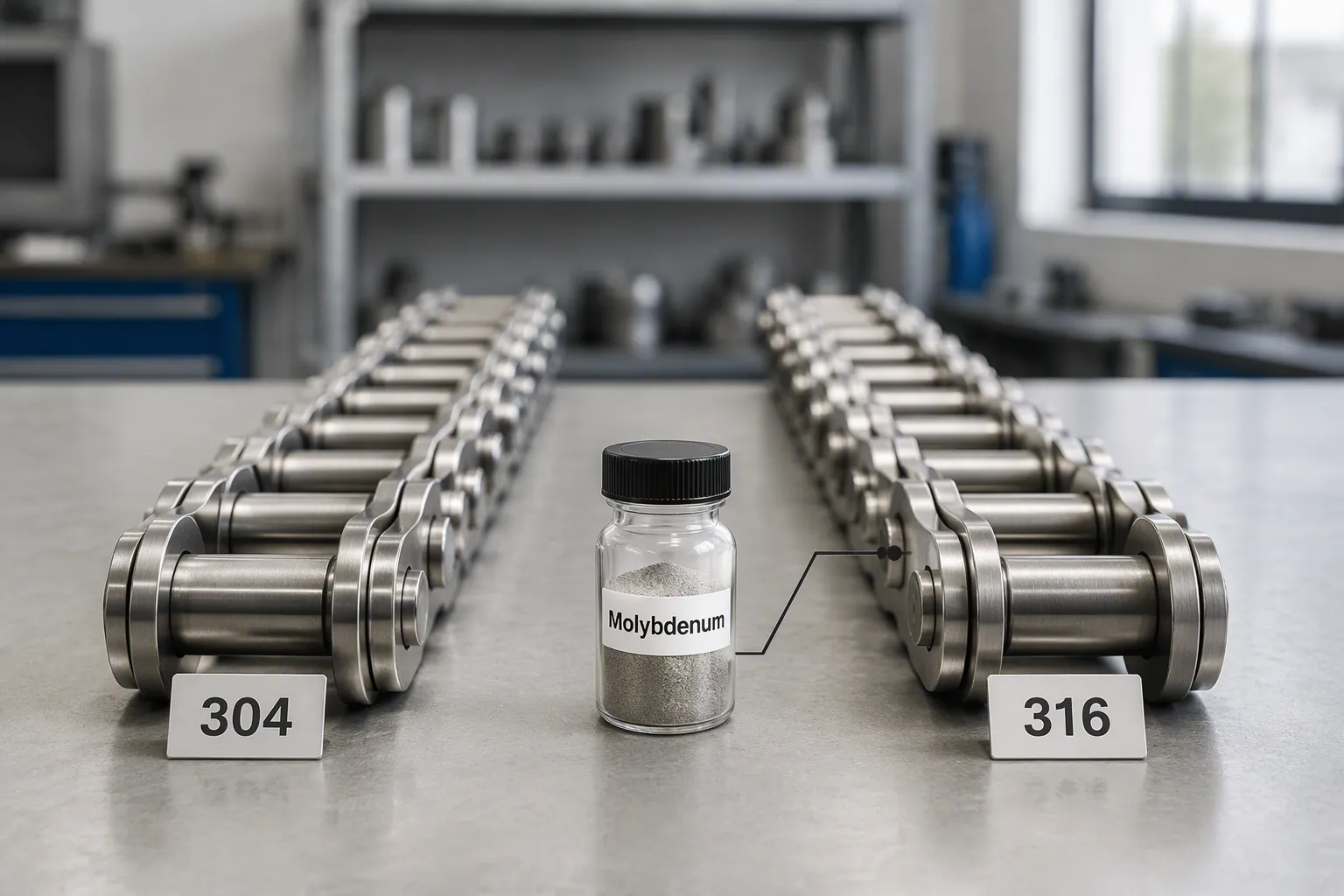
Both grades are austenitic, both rely on a chromium oxide passive layer, and both are stocked as conveyor chain; the alloying difference decides where each one survives.
What Grade 304 and Grade 316 Are
Both grade 304 and grade 316 are austenitic stainless steels, covered by the same standard specification for chromium-nickel stainless steel plate, sheet and strip. Manufacturers use these two grades most often for stainless steel roller chains and similar conveyor components. They share a chromium oxide surface layer that protects the base metal from rust. That shared foundation explains why both grades perform well in many everyday settings.
304: The General-Purpose Workhorse
Grade 304 contains roughly 18% chromium and 8% nickel, which earns it the familiar 18/8 label. The alloy delivers solid corrosion resistance in ordinary indoor and outdoor conditions. It machines well, forms easily, and stays affordable. These traits make 304 stainless steel a common first choice for general conveying duty.
316: The Molybdenum-Enhanced Grade
Grade 316 keeps a similar chromium and nickel base but adds 2–3% molybdenum. Grade 304 contains no molybdenum at all. That single alloying element stabilizes the chromium oxide layer and strengthens resistance to chlorides and aggressive ions. The table below shows the typical composition ranges for both grades.
| Element | 304 SS | 316 SS |
|---|---|---|
| Chromium (Cr) | 17.5–20.0 % | 16.0–18.5 % |
| Nickel (Ni) | 8.0–11.0 % | 10.0–14.0 % |
| Molybdenum (Mo) | 0 % | 2.0–3.0 % |
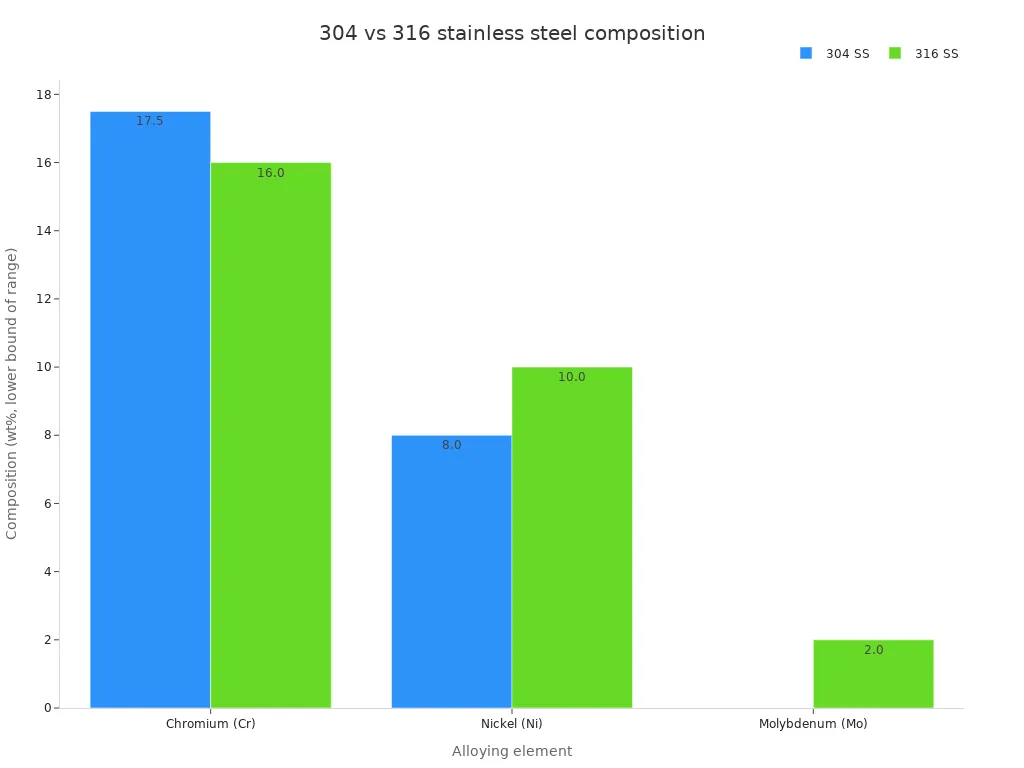
Molybdenum is the one element that separates the two grades: zero in 304, 2–3% in 316.
Key Differences in One View
The 304 vs 316 stainless steel comparison comes down to a handful of practical differences. Corrosion resistance favors 316 in chloride-rich settings. Mechanical strength is close in the annealed state, though cold-worked 316 reaches slightly higher tensile values. Temperature tolerance is broadly similar for both grades. Compliance demands often push buyers toward 316 in food and pharmaceutical work. Cost favors 304 by a clear margin.
| Property | Grade 304 | Grade 316 |
|---|---|---|
| Corrosion resistance | Good in general conditions | Better resistance to chlorides and chemicals |
| Tensile strength (annealed, min) | ≥515 MPa | ≥515 MPa |
| Tensile strength (cold-rolled) | 540–720 MPa | 580–750 MPa |
| Hardness (annealed) | ≤201 HBW | ≤217 HBW |
| Temperature range | Broad, similar to 316 | Broad, similar to 304 |
| Compliance fit | General food and industrial use | Washdown, pharma, marine duty |
| Relative cost | Baseline | 20–40% higher |
How to Use This Comparison
Readers should treat this table as a filter, not a verdict. Start with the corrosion column. A dry warehouse line rarely justifies the 316 premium. A washdown bay or a coastal plant shifts the answer toward 316. Next, check the compliance column against the standards the facility must meet. Then weigh the cost gap. The premium on 316 stainless steel buys longer service life in aggressive settings, and that trade-off deserves a full review in later sections.
The chart above makes the alloying difference visible at a glance. Molybdenum sits at zero for 304 and climbs to 2–3% for 316. That gap drives most of the performance split between the two grades. Buyers who understand the composition can predict how each chain will behave before the first installation.
This overview also sets up the deeper comparisons that follow. Corrosion resistance, load capacity, temperature behavior, compliance, and cost each get their own treatment. Readers who already know their operating environment can move straight to the relevant section. Those still weighing options can use the table to narrow the field. Either path leads to the same goal: a stainless steel conveyor chain matched to real site conditions rather than habit or guesswork.
One caution applies to every reader. The 304 vs 316 decision is not about which grade is better in absolute terms. It is about which grade fits the job. A well-chosen 304 chain returns better value than an over-specified 316 chain, and a well-chosen 316 chain outlasts 304 in harsh duty. Both grades earn their place across the stainless steel grades used in conveying equipment. The same logic extends to related families such as 304 vs 316 vs 310 stainless steel conveyor belts, where heat resistance adds another variable. For now, the composition and property differences above give readers a reliable starting point for the sections ahead.
Corrosion Resistance of Each Stainless Steel Conveyor Chain
How Grade 304 Performs Day to Day
Grade 304 handles most everyday conveying duty without trouble. Indoor lines, dry goods, and light washdown areas rarely stress the alloy. The chromium oxide layer reforms after scratches and keeps the base metal protected. That self-healing behavior explains why 304 stainless steel serves so many general-purpose installations at a lower price point.
The limits appear under sustained chemical exposure. Grade 304 has a pitting resistance equivalent number (PREN) of about 19. Grade 316 reaches roughly 25–26. That gap matters once chlorides enter the picture. As a rule of thumb, a 304 chain exposed to chloride levels around 200 ppm begins to show chloride pitting on general surfaces. Acid rinses accelerate the same damage.
Why Grade 316 Resists Harsh Conditions
Grade 316 stainless steel carries 2–3% molybdenum in its chemistry. That addition stabilizes the passive layer against aggressive ions. The result is markedly better chloride resistance and a longer service window in chemical attack. Washdown bays, food plants, pharmaceutical suites, and marine duty all favor this grade for that reason.
Chlorides, Salt, and Washdown Chemicals
Salt and cleaning chemicals attack the weak points of a chain first. Moisture trapped at the pin-to-bushing interface creates a crevice. Sugar-laden residue lowers the local pH and deepens the attack. Side plates collect residual moisture at flexing zones and develop pits. Grade 316 stainless steel resists this pattern far longer than 304 in chloride environments.
| Failure Mode | Location on Chain | Trigger / Condition |
|---|---|---|
| Crevice corrosion | Pin-to-bushing interface (flex points) | Moisture trapped by sugar-laden residue; localized pH drop |
| Pitting | Side plates | Residual moisture and locally lowered pH at flexing zones |
| Chloride-induced pitting | General 304 surface | Chloride concentration around 200 ppm |
| Acid-rinse pitting | General 304 surface | Sustained acid rinse exposure |
When 304 Is Still the Smarter Pick
Grade 304 remains the right call for low-chloride, caustic-dominant lines. Many general-purpose applications never approach the exposure levels that justify the 316 premium. Buyers who know their chemistry can specify 304 with confidence and save on purchase price. The grade is sufficient for a large share of conveying work.
Matching Corrosion Risk to Your Facility
A salt water immersion test offers a practical way to compare 304 and 316 chains before purchase. The test exposes both grades to the same aggressive medium and reveals which one pits first. Buyers weighing 304 vs 316 can use that result alongside their own washdown schedule and chemical list.
Facility conditions drive the final call. Dry warehouses and caustic-dominant lines suit 304. Salty product contact, frequent acid rinses, and coastal air point toward 316. The same logic extends across related product families, including 304 vs 316 vs 310 stainless steel conveyor belts, 304 stainless steel conveyor belts, and 316 stainless steel conveyor belts. Each family applies the same chloride-resistance principle. Readers who map exposure first will avoid both under-specifying and over-specifying their chain.
Not sure which grade the washdown chemistry calls for?
Send the cleaning agents, chloride levels and rinse schedule for the line. DONGCHUAN (DCC) can match a stainless grade and chain series to that exposure profile before the order is placed.
Get a QuoteView Stainless ChainsMechanical Properties and Load Capacity
Strength and Hardness Compared
Grade 316 stainless steel carries slightly higher tensile strength and hardness than grade 304 in the cold-worked condition. The annealed values sit close together, so a buyer comparing catalog sheets will see a narrow gap. Grade 304 is the more ductile of the two, with higher elongation, which helps on layouts with tight curves and frequent flexing. Both grades share a similar modulus of elasticity, around 193 GPa, so stiffness is not a differentiator.
The evidence table below shows how temper changes the picture for 304 ss. Yield strength climbs sharply as the material moves from annealed to full hard, while elongation falls at the same time. The figures follow the cold-rolled stainless strip specification that sets temper designations.
| Alloy | Temper | Yield Strength Min 0.2% offset (psi) | % Elongation in 2" Min |
|---|---|---|---|
| 304 | Annealed | 30,000 | 40% |
| 304 | 1/4 Hard | 75,000 | 10% |
| 304 | 1/2 Hard | 110,000 | 6% |
| 304 | Full Hard | 140,000 | 3% |
Under ASTM A240, annealed 304 and annealed 316 carry the same minimums: 515 MPa tensile strength, 205 MPa yield strength (0.2% offset), and 40% elongation in 50 mm. The grades are therefore interchangeable on paper in the annealed state. The practical difference appears after cold working, where 316 work-hardens faster and reaches slightly higher tensile values.
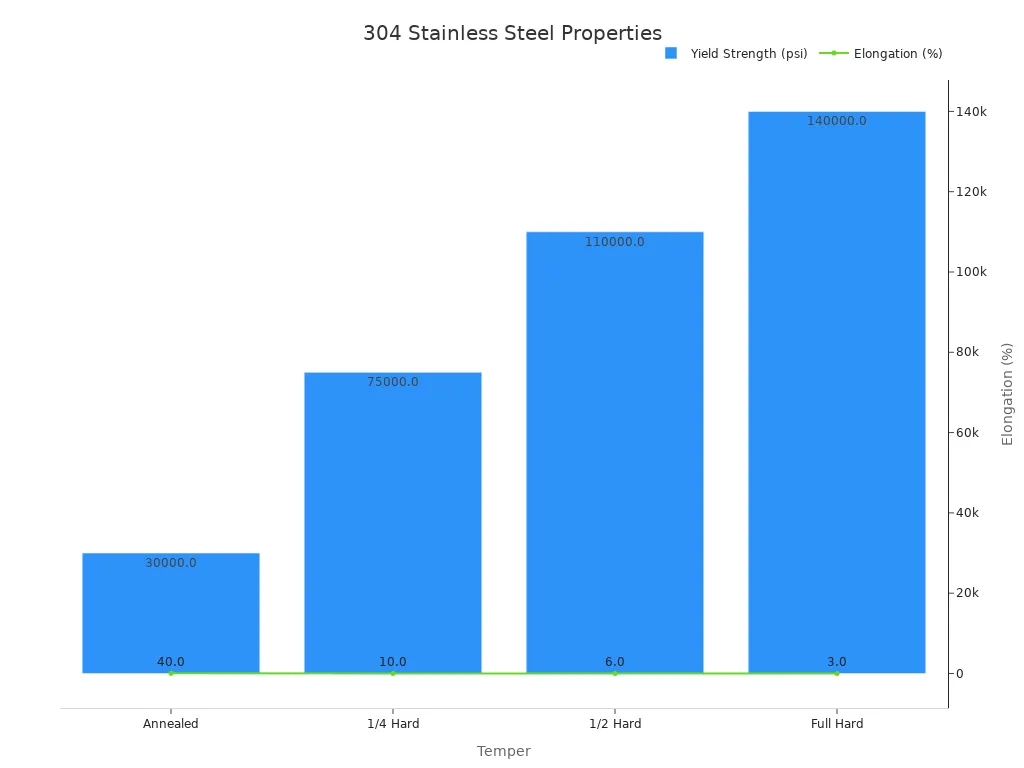
Yield strength rises and elongation falls as 304 moves from annealed to full hard.
Wear and Fatigue in Continuous Operation
Continuous duty punishes chains at the pin, bushing, and roller contacts. Hardened round parts in stainless steel chains can carry a higher working load and deliver longer wear life than standard 304 and 316 series chains. That gain comes with a trade-off: the hardened parts give up some corrosion resistance. Buyers running a 304 or 316 stainless steel conveyor line under heavy cyclic loads should weigh that balance carefully.
Fatigue life depends on load per link and the number of flex cycles per hour. A chain running at high speed with a light load may outlast a slow chain under heavy tension. Matching temper to the duty cycle matters more than picking the harder grade by default.
Choosing a Grade for Heavy-Duty Lines
Heavy-duty specification starts with the working load, then checks temper and hardness against the duty cycle. A line that carries constant tension favors a harder temper for wear life. A line with tight curves and frequent flexing favors the more ductile annealed 304. Buyers should confirm the load rating against the actual chain pitch and pin diameter before committing.
The final check covers corrosion exposure. A hardened chain in a washdown bay may pit faster than a standard 316 chain, even with its higher working load. Readers who match temper, load, and environment together will specify a chain that lasts. The grades differ in small ways on paper, and those small ways decide real service life.
Temperature Resistance: Heat, Cold, and Cycling
Heat and cold change how a conveyor chain behaves. Both alloys tolerate a wide band of operating temperatures. The upper limits differ, and that difference decides some specifications.
Performance at Elevated Temperatures
Grade 304 and grade 316 both hold their structure at high heat. Neither alloy softens quickly in a hot zone. Published chain guidance sets a ceiling for each grade at low chain speeds.
| Chain Specification | Material | Maximum Recommended Operating Temperature |
|---|---|---|
| SS specification | 304 stainless steel | 650°C (at low speeds) |
| NS specification | 316 stainless steel | 700°C (at low speeds) |
The 316 stainless steel ceiling sits above the 304 limit. That margin comes from the molybdenum content, which stabilizes the oxide layer under thermal load. A kiln exit or a drying tunnel may run hot enough to make that margin matter.
Speed deserves equal attention. Both ratings assume low chain speeds. A fast line raises friction heat at the pins and bushings, and the combined temperature can exceed the published ceiling. Buyers should treat the table as a starting point and confirm the duty cycle with the chain supplier.
Behavior in Freezing and Washdown Cycles
Cold storage and freezer tunnels pose less risk to the alloy itself. Austenitic stainless steels keep their toughness as temperatures fall, and neither 304 nor 316 turns brittle in typical cold-room service. The greater threat comes from moisture and repeated freeze-thaw cycles at the pin joints.
Washdown adds a second stress. A chain that moves from a hot wash to a cold rinse expands and contracts with every cycle. Both grades handle this movement well, though repeated cycling works the flex points over time. Operators should watch for loosened pins and worn bushings rather than alloy failure.
Where Temperature Limits Affect Your Choice
Temperature rarely decides the grade alone. A conveyor line that runs below the 304 ceiling gains nothing from the higher 316 rating. A process that pushes past 650°C at low speed needs the 316 ss specification, and the 304 ss option falls outside its rated window. Buyers who ignore the speed caveat can overestimate either limit.
Buyers should rank the factors in order. Corrosion exposure comes first, then temperature, then compliance and budget. A hot, dry line with no chemical exposure may suit 304. A hot line with washdown chemicals points to 316 stainless steel. The two alloys differ by a modest temperature margin, and that margin only matters when the process actually reaches it.
Compliance and Hygiene Requirements
Food-Grade and Sanitary Applications
Food plants judge a chain on more than corrosion resistance. Auditors want proof that every contact surface meets food-contact rules. Both 304 and 316 stainless steel are accepted for food-contact equipment under FDA regulations and NSF/ANSI 51. Grade 304 remains the common industry choice for food-contact surfaces, and many sanitary lines run it without issue.
Modular stainless steel conveyor systems often carry food approval under both FDA and EU frameworks. That dual compliance gives buyers a clear path for export-focused plants. Bakery equipment follows ANSI/ASB Z50.2, the BISSC sanitary standard. Dairy and ready-to-eat operations look to the 3-A sanitary standards for mechanical conveyors handling dry products.
Always verify FDA, EU and GB 4806 compliance certificates when specifying food-grade conveyor systems. Certificates should name the exact alloy and the surface finish, not just the equipment family.
Chemical and Pharmaceutical Environments
Pharmaceutical suites demand tighter control than food plants. Cleaning agents run stronger, and residue limits sit lower. Grade 316 stainless steel earns preference here because its molybdenum content resists the acid and chloride washes these rooms use. The same corrosion resistance that protects the chain also protects product purity.
Chemical plants apply similar logic. Buyers should confirm that the selected grade meets the site cleaning chemistry before purchase. Grade 304 suits many dry chemical duties, while 316 handles aggressive washdown. Both grades appear in validated processes, and the choice follows the exposure profile rather than a blanket rule.
Documentation and Traceability Considerations
Paperwork carries real weight in regulated plants. The preventive-controls rule for human food requires written food safety plans with sanitation controls and preventive measures. A chain supplier who cannot support that plan becomes a liability at audit time.
Buyers should request material certificates and compliance declarations with every order. Relevant references include 21 CFR Part 177 for polymers, 21 CFR 177.2600 for rubber articles, 21 CFR 178.3570 for lubricants, and 21 CFR Parts 174, 177, and 178 generally. A 304 ss chain and a 316 chain should each arrive with traceable heat numbers. Documented grades speed validation and reduce rework during commissioning.
Cost: Purchase Price vs Total Cost of Ownership
Upfront Price Differences
Grade 304 tends to win on sticker price. The alloy carries no molybdenum, and that simpler chemistry keeps mill pricing lower. Buyers who compare quotes for general conveying duty usually see 304 at the bottom of the sheet. Its relative affordability explains why so many plants standardize on this grade for everyday lines.
Grade 316 carries a higher upfront price. The molybdenum addition and higher nickel content drive the gap, and the earlier cost comparison put the premium at roughly 20–40%. A buyer who stops at the invoice will pick 304 every time. That shortcut works only when the operating environment stays mild.
Maintenance, Downtime, and Replacement Costs
The purchase price tells half the story. In demanding environments, 316 stainless steel proves more durable and easier to maintain than 304. A chain that resists chloride attack needs fewer inspections, fewer pin replacements, and fewer unplanned stops. Each avoided shutdown carries value that never appears on the original quote.
Grade 304 still holds its own in low-corrosion duty. A dry warehouse line may run either grade for years with similar upkeep. The split appears in washdown bays, chemical rooms, and coastal plants. There, a pitted 304 chain forces early replacement, and the second purchase erases the savings from the first.
Calculating the Real Payback
A sound evaluation weighs maintenance, downtime, and replacement costs alongside the invoice. Buyers should total the expected service life of each option, the labor hours tied to upkeep, and the production lost during a stoppage. Those figures often close the price gap between the grades.
The math favors 316 when corrosion risk runs high. A longer service window spreads the higher purchase price across more operating hours. The 304 ss option wins when exposure stays low and the line never approaches the conditions that shorten chain life. Buyers who run this comparison before ordering will choose with confidence rather than habit.
Running the payback numbers on a new line?
Share the duty cycle, cleaning regime and expected service life. DONGCHUAN (DCC) can quote both grades against the same chain series so the comparison rests on identical specifications.
Get a QuoteSee All Chain SeriesMatching the Grade to Your Application
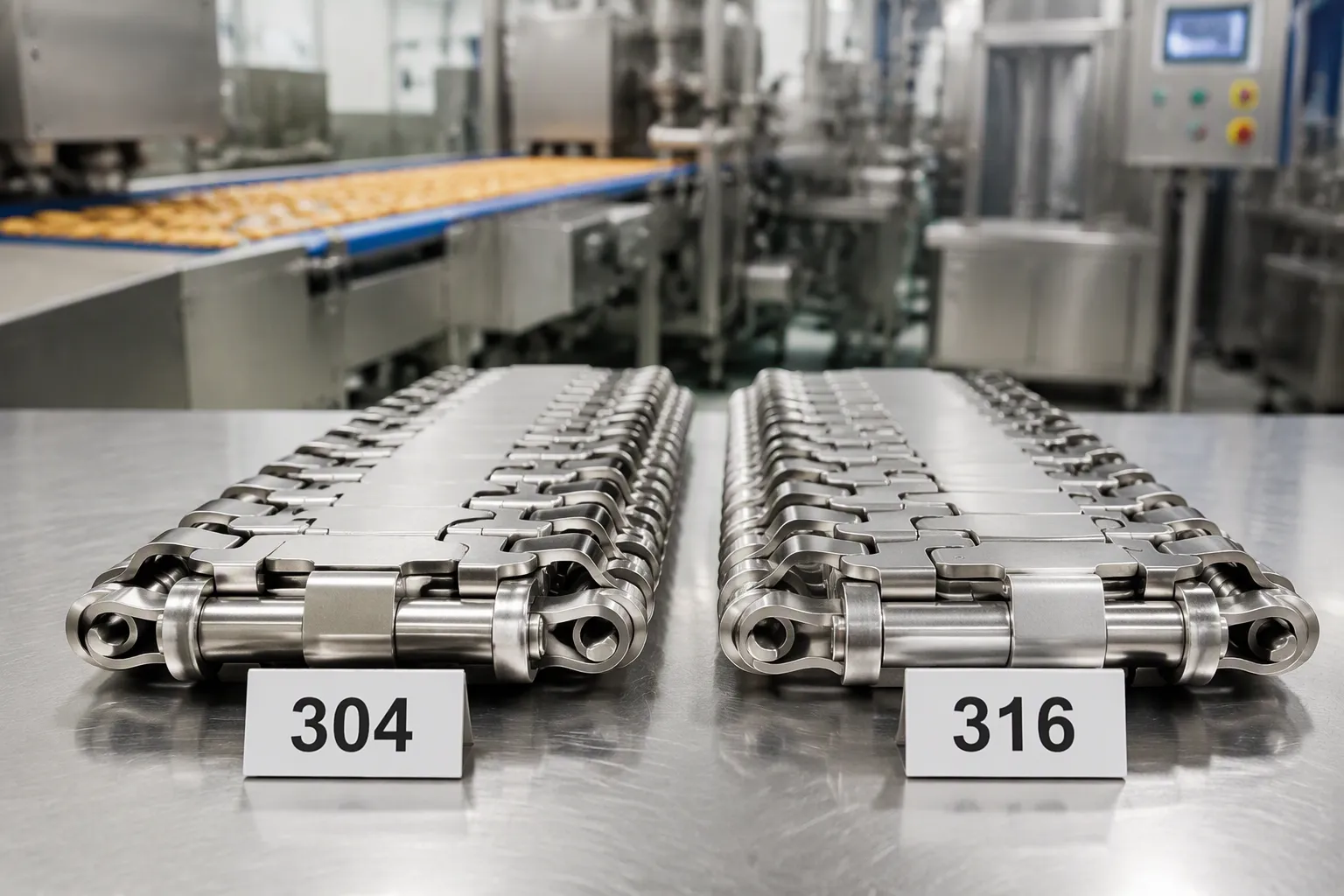
Matching the grade to the application means reading the environment first and the price sheet second.
A common pattern in specification is to over-specify 316 when 304 would serve. The premium grade feels safer on paper. In practice, it adds cost without adding service life when the line never meets chlorides or harsh chemicals. Matching the grade to actual exposure solves this problem before the order goes out.
When Grade 304 Is the Right Fit
Grade 304 stainless steel chains serve general applications well. Strong corrosion resistance and good weldability keep them in wide use. The table below shows where this grade earns its place.
| Application Area | Notes |
|---|---|
| General food processing | Baking, cooling, pasteurizing, blanching |
| IQF spiral freezers and tunnel freezers | Low-temperature freezing applications |
| Pharmaceutical tablet conveying and drying | Pharma handling and drying |
| General industrial conveying | Suitable in non-chloride environments |
| Heat treatment | Up to about 650°C at low chain speeds |
Grade 304 stainless steel chains are widely used for general applications thanks to their strong corrosion resistance and good weldability.
The selection rationale stays simple. Grade 304 is cost-effective, and it is sufficient when no chlorides are present and neutral cleaning agents are used. A bakery line, a freezer tunnel, or a dry pharmaceutical suite fits this profile. Buyers who choose 304 for these duties get reliable service at a lower price.
When Grade 316 Is Worth It
Grade 316 stainless steel earns its premium under aggressive exposure. The 2–3% molybdenum content improves resistance to chlorides, acids, and pitting and crevice corrosion. Industry guidelines map the split clearly:
Mild, clean, low-aggressive environments suit 304, which carries no molybdenum and offers good formability at lower cost.
Chloride, marine, coastal, or chemical exposure calls for 316, where molybdenum improves chloride resistance.
Grade 304 lacks molybdenum, so it is vulnerable to chloride-induced pitting and crevice corrosion in chloride environments.
Grade 316 is not stronger than 304 in a general sense. Its advantage is specifically greater resistance to chloride pitting and chemical attack.
Saltwater and coastal installations, chemical processing, and de-icing salt exposure all point to 316. Indoor and dry environments, kitchens, and general food processing point to 304. Fresh water, organic acids, and household cleaners also perform well with 304. This 304 vs 316 stainless steel split reflects exposure, not prestige.
Specifying Your Chain With Confidence
A simple decision framework keeps material selection on track. Work through four questions in order:
Corrosion exposure: does the line meet chlorides, salt, or aggressive chemicals? If yes, choose 316. If no, 304 remains viable.
Temperature: does the process exceed the 304 ceiling? Heat treatment near 650°C sits at the top of the 304 range, so temperature alone rarely forces the upgrade.
Compliance: does the facility require documentation for washdown chemistry or pharmaceutical validation? Stronger cleaning agents favor 316.
Budget: run the cost comparison against expected service life, not invoice price alone.
Ordering details deserve the same care. Chain pitch is selectable from 12.7 mm to 101.6 mm depending on series, and attachment top plates can be built to any practical dimension. Surface finishes include zinc plating, nickel plating, Dacromet coating, and black oxide. Buyers can specify roller type and material, surface treatment, and attachment spacing. Working load and operating temperature depend on the chain number, the temper and the attachments, so the rating should be confirmed against the specific configuration rather than a family-wide figure. Common standards include ISO 9001:2015, ISO 606, ISO 1977, ANSI B29.1, and DIN 8165/8167.
Stainless steel roller chains divide by application into industrial, agriculture, automotive, food processing, and material handling categories. Food and pharmaceutical work favors stainless steel for hygiene and cleaning tolerance. Specialty chains cover high-temperature, corrosive, or specific load and speed needs. The same logic extends across related families such as 304 vs 316 vs 310 stainless steel conveyor belts, where heat resistance adds a variable. Readers who confirm the right stainless steel grade against documented exposure data avoid both under-specifying and paying for corrosion resistance the line never uses.


Ready to specify a stainless steel conveyor chain?
Tell us the pitch, attachment layout, working load and cleaning environment. DONGCHUAN (DCC) builds each chain to order and can confirm the grade, temper and finish in one quotation.
Get a QuoteBrowse Conveyor ChainsFAQ
Does grade 316 always outperform grade 304?
No. Grade 316 wins on chloride and chemical resistance, thanks to its molybdenum content. Grade 304 matches it closely on strength, temperature tolerance, and general duty performance. A dry, low-corrosion line gains little from the upgrade. The better grade is the one matched to actual site conditions.
Which grade suits washdown and food plants?
Grade 316 stainless steel handles frequent washdown, acid rinses, and salty product contact far better. Grade 304 remains the common industry choice for general food-contact surfaces and meets FDA and NSF/ANSI 51 requirements. Plants with aggressive cleaning chemistry should lean toward 316.
At what chloride level does 304 start to pit?
Grade 304 begins to show chloride pitting on general surfaces at concentrations around 200 ppm, a widely used rule of thumb rather than a hard threshold. Its pitting resistance equivalent number sits near 19, while grade 316 reaches roughly 25–26. A salt water immersion test confirms how each grade behaves under a facility's real exposure.
Do the two grades differ in strength?
Barely, in the annealed state. Both carry a 515 MPa minimum tensile strength and a 205 MPa minimum yield strength under ASTM A240. Cold-worked 316 stainless steel reaches slightly higher tensile values and hardness. Grade 304 is the more ductile of the two. Heavy-duty lines benefit more from temper selection than from grade choice alone.
What temperature can each chain handle?
Published limits at low chain speeds reach 650°C for 304 and 700°C for 316. Both grades stay tough in cold storage and freezer tunnels. Fast lines raise friction heat at the pins, so buyers should confirm the duty cycle with the supplier.
Is 316 worth the higher price?
Only under aggressive exposure. The 316 premium runs roughly 20–40% over 304. In washdown bays, chemical rooms, and coastal plants, longer service life and fewer stoppages offset that gap. In dry warehouses, 304 delivers the same uptime for less money.
Can a buyer compare the grades before ordering?
Yes. A salt water immersion test exposes samples of 304 and 316 stainless steel to the same medium and shows which pits first. Buyers should pair that result with their washdown schedule, chemical list, and compliance needs. Documented test data supports a confident specification.
Which grade should a general-purpose line specify?
Grade 304 ss covers most routine conveying duty at a lower price. Buyers should check corrosion exposure first, then temperature, compliance, and budget. A 304 and 316 stainless steel comparison run in that order usually points to the right chain without over-specifying.
References
[1] ASTM A240/A240M — Standard Specification for Chromium and Chromium-Nickel Stainless Steel Plate, Sheet, and Strip. astm.org
[2] ASTM A666 — Standard Specification for Annealed or Cold-Worked Austenitic Stainless Steel Sheet, Strip, Plate, and Flat Bar (temper designations, yield strength and elongation). astm.org
[3] U.S. Food and Drug Administration. 21 CFR Part 117 — Current Good Manufacturing Practice, Hazard Analysis, and Risk-Based Preventive Controls for Human Food. ecfr.gov
[4] 3-A Sanitary Standards, Inc. — sanitary standards for mechanical conveyors and dry-product handling equipment. 3-a.org
Alloy compositions, annealed mechanical properties and temper values follow the ASTM specifications cited above. Chain temperature ceilings follow published conveyor-chain guidance for low-speed service and should be confirmed with the supplier for the specific chain number.

