How Strong is Welded Steel Chain? Load Capacity and Testing Standards Explained
The strength of a welded steel chain comes down to one number: its working load limit (WLL). Grade, link size, and manufacturing quality set that limit. Standardized testing then verifies it. This distinction matters for both safety and purchasing. Overloading remains a leading cause of chain failure, and a chain pushed past its rating can stretch, crack, or break without warning. Buyers who understand the rating system choose the right product and avoid costly mistakes on the job site. The sections below explain working load limits, safety factors, testing standards, chain grades, selection criteria, and inspection practices in plain terms. Each topic builds toward one goal: matching a chain to its load with confidence.
Key Takeaways
Working load limit (WLL) is the maximum load a chain should carry in normal service.
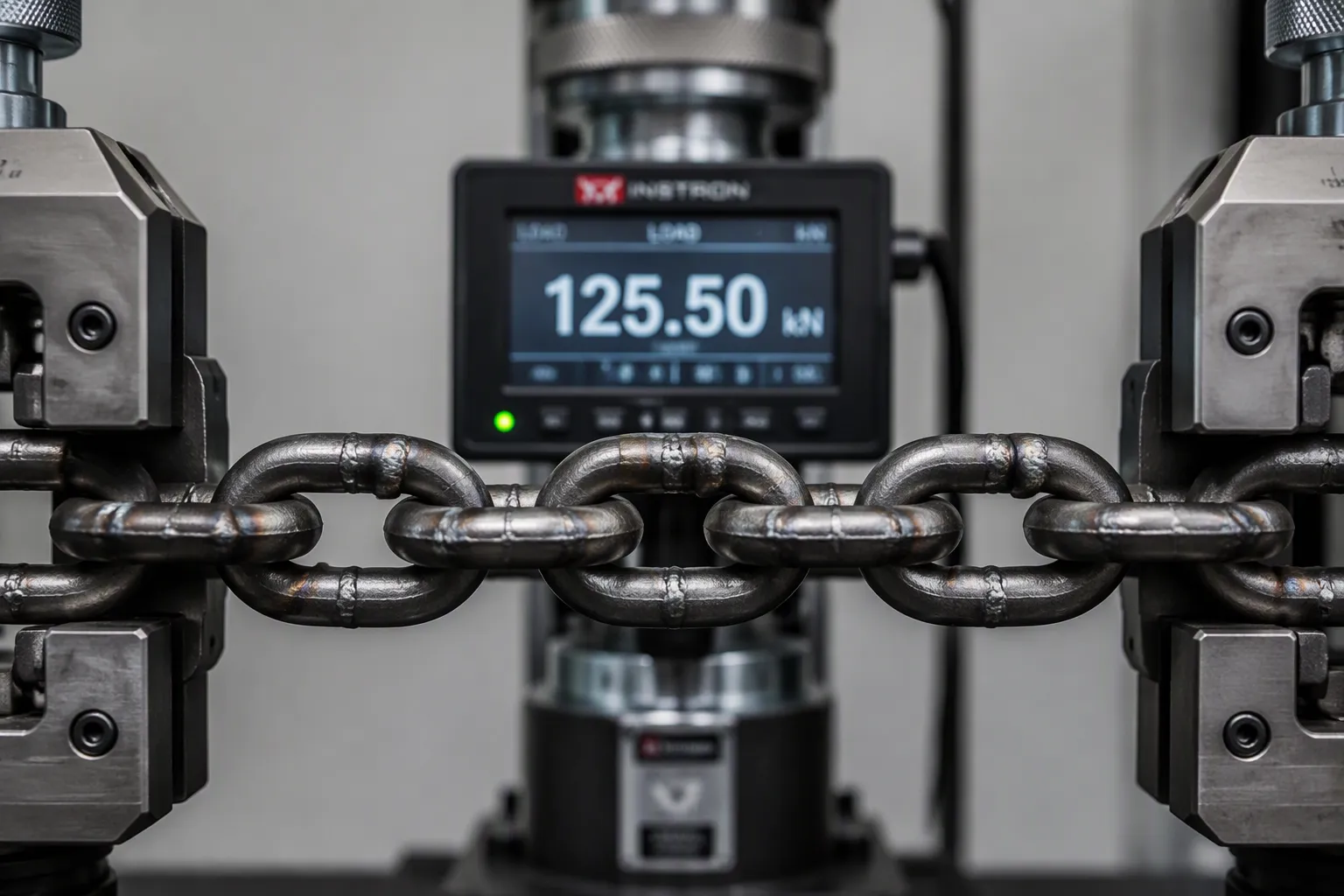
Breaking strength is the load at which a chain fails, and it is usually 4 to 5 times the WLL.
Proof testing applies a load without permanent deformation to confirm the chain meets its rating.
Chain grade and size determine load capacity, with higher grades like 80 and 100 offering more strength.
Never exceed the WLL, because overloading can cause sudden and dangerous chain failure.
Match the chain grade to the job: Grade 70 for tie-downs, Grade 80 or 100 for overhead lifting.
Inspect chains before each use for wear, cracks, or damage, and remove any chain that fails inspection.
Buy certified chains with test certificates and traceability documents to ensure quality and safety.
What Working Load Limit Means
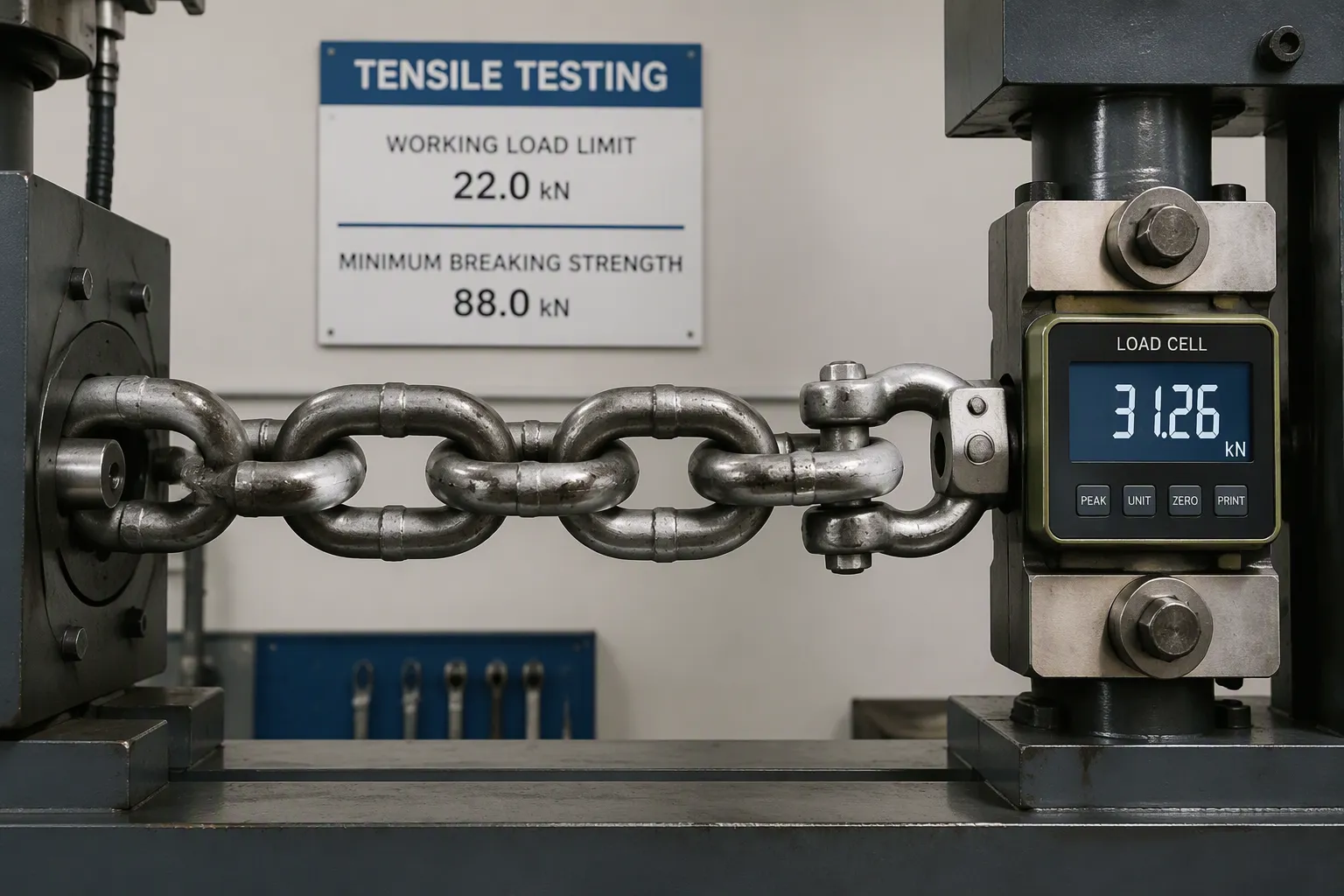
The working load limit (WLL) is the maximum load a welded steel chain should carry in normal service. Manufacturers express the WLL in pounds. A higher WLL means a stronger chain. This single rating gives buyers a clear, comparable number for matching a chain to a job.
WLL vs. Breaking Strength
The WLL and the breaking strength describe two different things. The WLL is the safe working capacity. The breaking strength is the load at which the chain actually fails. Testing determines breaking strength: an increasing load is applied until the chain breaks, and the force at failure becomes the breaking strength. The WLL is then calculated from that figure and a safety factor using a simple relationship: WLL = breaking strength / safety factor.
Quality chains are designed so that breaking strength is a multiple of the WLL, typically 4:1 or 5:1. A chain rated at a 5,000-lb WLL should show a minimum breaking strength of 20,000–25,000 lbs in destructive testing. That gap between the working rating and the failure point is what protects workers and equipment from unexpected overloads.
The Safety Factor Explained
The safety factor is the ratio between breaking strength and WLL. It absorbs shock loads, minor overloads, and the natural wear that accumulates over a chain's service life. Safety factors vary by application. General lifting generally uses a factor of 4 or 5. Applications involving human safety, such as stage rigging, may use factors up to 8. A minimum 4:1 safety factor is common for welded steel chain, while overhead lifting generally requires at least 5:1.
Proof Load and Its Purpose
Proof testing confirms that a chain meets its rated working requirements. The manufacturer applies a proof load, commonly about 2–2.5 times the WLL, without permanent deformation. A chain that stretches or fails during proof testing does not pass. Destructive breaking tests then verify failure at roughly 4–5 times the WLL. Together, these two tests separate a reliable chain from one that only looks the part.
Factors That Affect Load Capacity
Several variables shape how much load a chain can safely handle. Grade and size set the theoretical capacity. Manufacturing quality and service conditions determine whether the chain actually delivers that capacity in the field.
Grade, Size, and Manufacturing
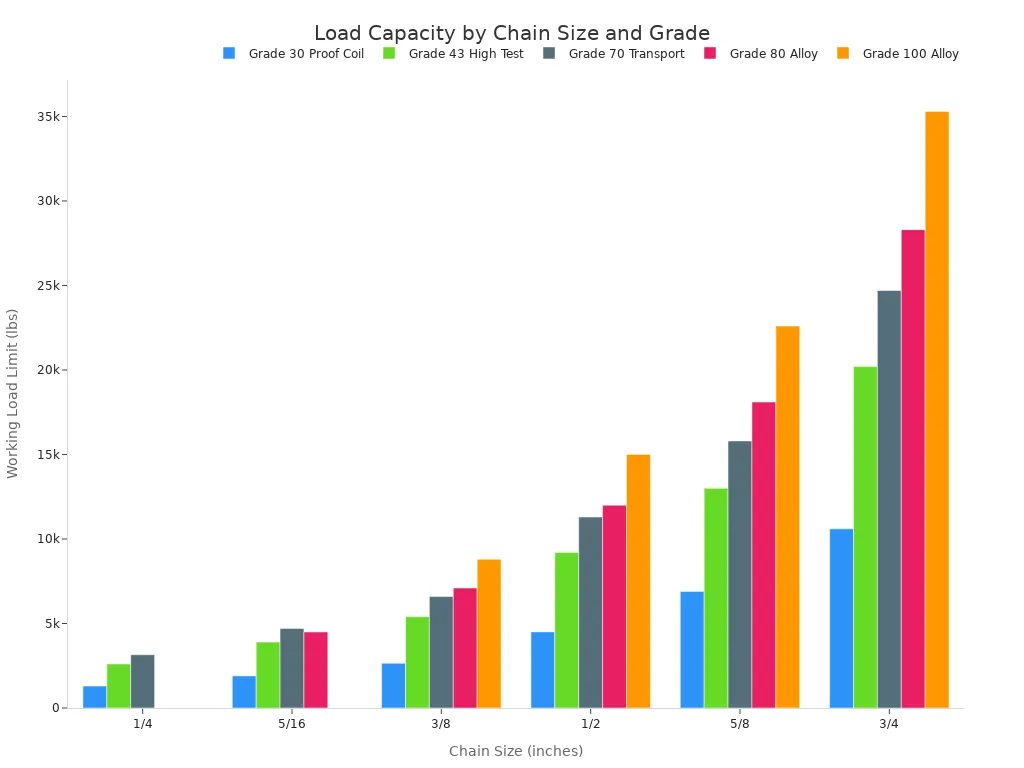
Chain strength depends primarily on the grade of steel used—low, medium, or high tensile. Higher tensile grades allow a smaller, lighter chain to achieve the same strength, so grade directly determines load capacity for a given size. Size scales that capacity further. For any fixed size, increasing grade raises the load limit; for any fixed grade, increasing size raises it as well. The chart below shows how working load limits climb across sizes and grades.
Metallurgical grade alone does not guarantee real-world breaking strength. The chain must also be of sound manufacturing quality, free from rust, bad wear, and especially defective welds. Poor-quality stainless chain welded with filler material by an incompetent manufacturer can suffer intergranular corrosion, leading to rapid weld failure. Inadequate finishing treatments cause surface rusting. Grade sets the theoretical strength, size scales the capacity, and manufacturing quality determines whether that capacity is actually realized.
Wear, Corrosion, and Environment
Service conditions erode capacity over time. Abrasion thins link cross-sections. Corrosion pits the surface and weakens welds. High temperatures can alter the steel's properties. A chain that started at a given WLL may no longer deserve that rating after months of harsh duty. Regular inspection and appropriate coatings help preserve capacity in demanding environments.
Why You Should Never Exceed the WLL
The WLL exists because chain failure is sudden and dangerous. A chain pushed past its rating can stretch, crack, or break without warning. Shock loads and side pulls compound the risk, since they concentrate stress in ways the rating does not account for. The safety factor provides a margin, not a license to overload. Operators should treat the WLL as a hard ceiling and plan every lift, tie-down, and load-bearing task around it.
Testing Standards Behind the Rating
A working load limit means little without a standard behind it. Several organizations publish the rules that define chain classifications, test procedures, and workplace enforcement. Together, these standards turn a manufacturer's claim into a verifiable rating.
Key Standards Bodies
ISO, ASTM, and NACM
ISO 1834 specifies classifications and working load limits for welded steel chain, including grades such as G80 and G100. The NACM welded steel chain specification covers grades including Grade 100, Grade 80, Grade 70, and Grade 43. ASTM standards complement these documents with material and test requirements, as published by an international standards body. A chain built to one of these specifications carries a rating that buyers, engineers, and inspectors can check against a published reference.
Quality management systems support the paperwork side of compliance. ISO 9001 and API certifications support quality control and traceability from raw material to finished chain, in line with international quality standards. A certified plant documents each production step, so a buyer can trace a finished welded steel chain back to its steel source and heat-treatment records.
OSHA and Workplace Enforcement
OSHA enforces chain safety in American workplaces. The agency's rules and inspection guidelines give employers a legal benchmark for slings and lifting assemblies. Compliance is not optional in regulated industries, and inspectors check for proof-test records during workplace audits. The relevant rule is published by the federal occupational safety regulator and applies to alloy steel chain slings used in covered workplaces.
How Proof and Break Testing Work
Proof testing verifies that a chain meets its rated working requirements. The manufacturer applies a proof load, commonly about twice the working load limit, without permanent deformation. A chain that stretches or fails during the test does not pass. Destructive break testing then loads a sample until failure to confirm the breaking strength.
| Aspect | Requirement |
|---|---|
| Regulatory basis | OSHA 1910.184(e)(4) requires alloy chain slings to be proof tested before use, including new, repaired, or reconditioned slings. |
| Scope for welded chain | The OSHA standard covers all welded components; CPL 02-01-14B Guideline 1 requires welded alloy steel chain sling assemblies to be proof tested by the manufacturer or equivalent entity before use. |
| Why welding matters | Welding and heat-treating during assembly or repair can introduce human and mechanical defects into sling components. |
| Verification mechanism | The proof test is performed at twice the working load limit, certifying the sling meets the working requirements stated on its ID tag. |
| Outcome | A passed proof test assures manufacturing processes were followed correctly and the sling functions safely within its working load limits. |
Reading Certificates and Traceability
A test certificate is only useful when a buyer can read it. The document should name the standard applied, the grade, the proof load, and the batch or heat number. Those details let a purchaser confirm that the chain in hand matches the chain that was tested.
Traceability closes the loop. Batch numbers link finished chain to raw material records, heat-treatment logs, and test results. Buyers should request documentation with every order and keep it on file for inspection. A certificate without traceable batch data offers little protection when a question arises about a specific length of chain.
Welded Steel Chain Grades and Load Capacities
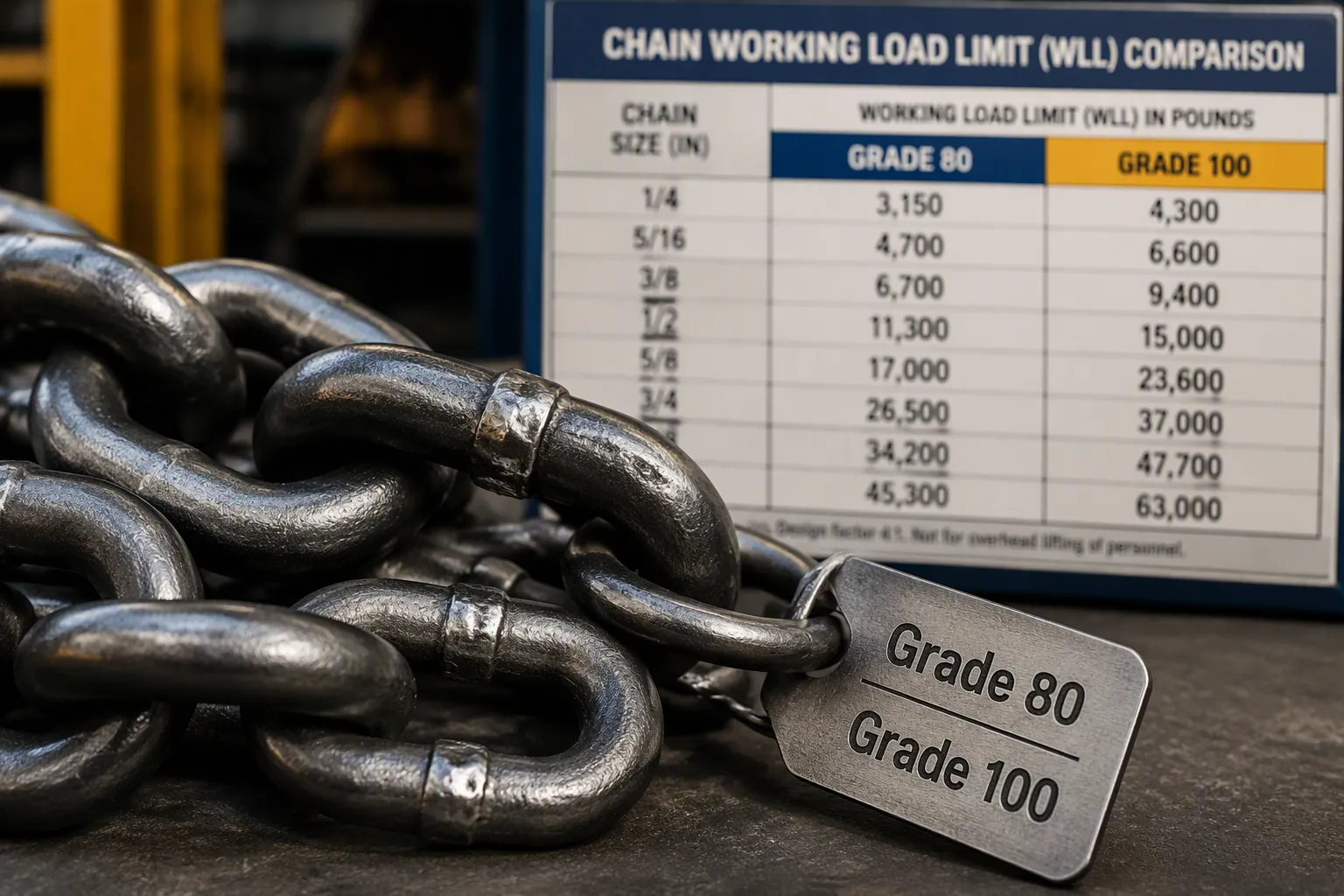
Grade is the single most useful label on a welded steel chain. It tells a buyer how much load a given link size can carry and which applications the chain suits. The grade system spans carbon steel chains built for utility work and alloy chains built for overhead lifting. Each step up the scale adds tensile strength, and each step carries its own rules for safe use.
Common Grades Explained
Grades 30, 43, and 70
Grade 30, known as proof coil, is the lowest grade of graded welded chain. It uses generic carbon steel and serves logging, trucking tie-downs, playground equipment, and bundling or sling assemblies where low carbon content is preferred. Proof coil welded chain has a maximum working load capacity ranging from 1,300 to 10,600 pounds depending on size. Grade 43, or high-test, offers a slightly higher strength-to-weight ratio than Grade 30 and often works interchangeably with it. General utility, towing, and load securement are its common duties. Grade 70, the transport grade, is the highest grade in the carbon category. Heat treatment gives it greater wear and abrasion resistance plus a higher strength-to-weight ratio. Trucking and cargo tie-downs are its main use, and a gold-colored finish typically identifies it. None of these three grades is recommended for overhead lifting.
Grades 80 and 100
Grade 80 marks the entry into alloy chain. Its minimum tensile strength reaches 800 newtons per square millimeter, and heat treatment makes it economical for overhead lifting, sling components, and heavy-duty tow work. Grade 100 raises the minimum tensile strength to 1,000 newtons per square millimeter. That 25 percent gain lets Grade 100 carry greater loads at the same size, or match a Grade 80 working load limit with a smaller diameter. The table below shows how the ratings compare across common sizes, and the chart that follows illustrates the same relationship.
| Chain size | Grade 80 WLL | Grade 100 WLL |
|---|---|---|
| 3/8 in | 7,100 lb | 8,800 lb |
| 1/2 in | 12,000 lb | 15,000 lb |
| 5/8 in | 18,100 lb | 22,600 lb |
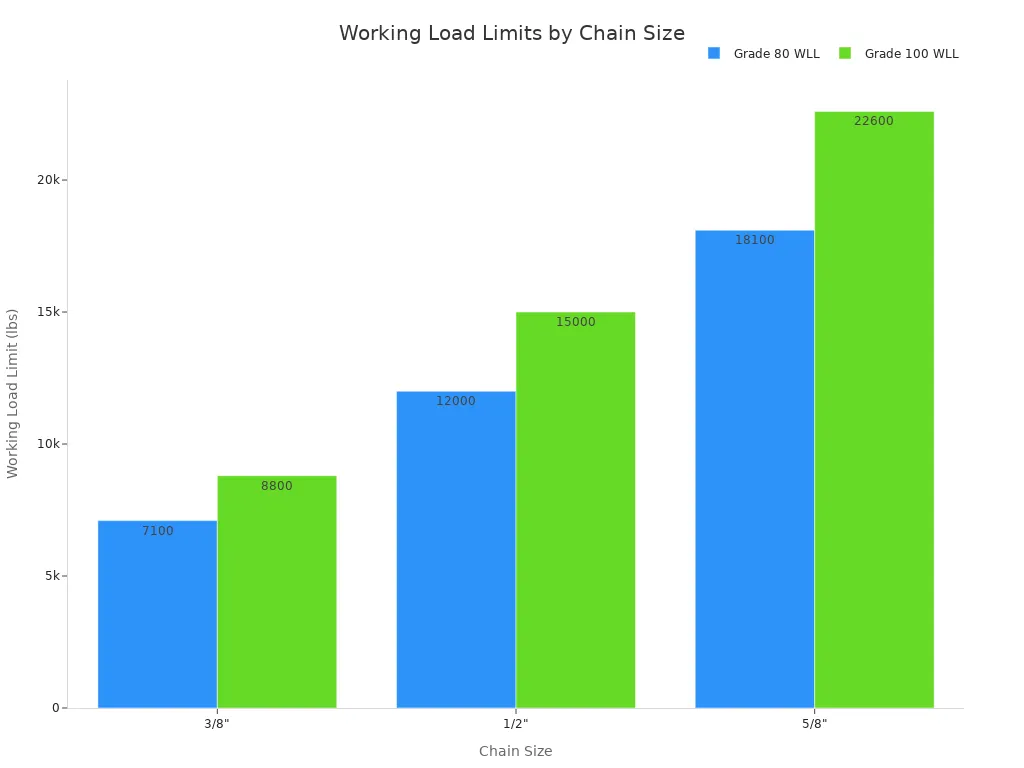
Values assume a single-leg vertical configuration. Grade 70 remains the recognized standard for transport work, Grade 100 has become the current default for lifting, and Grade 80 still performs well in many roles. Grade 120 enters service when a job needs the most capacity in the smallest possible size.
Matching Grade to Application
Load weight drives the grade choice first. Heavier loads call for higher-grade chain. Environmental conditions matter next: corrosive settings require stainless or galvanized steel. Frequent use demands durable, fatigue-resistant chain, and adequate safety margins help prevent breakage. A practical mapping follows from these factors. Grade 70 suits load securement and tie-downs. Grade 43 fits general industrial towing as a cost-effective carbon steel option. Grade 30 or 43 covers agricultural and farm work where economy matters more than peak strength. Grade 80 and Grade 100 serve rigging and overhead lifting, where alloy construction and certified ratings are mandatory.
How to Identify Welded Steel Chain Grade
Manufacturers stamp grade markings on links at regular intervals, roughly every six links. The stamp may read 7, 70, or 700 for Grade 70, and similar patterns identify the other grades. Letter codes also appear: L10 for Grade 100 alloy, L8 for Grade 80 alloy, L7 for Grade 70 transport (which also indicates DOT approval), L4 for Grade 43 high test, and L3 for Grade 30 proof coil. Heat-treated chain in Grades 70, 80, and 100 also carries a trace code, a mix of letters and numbers in sets of two or three, that records manufacturing history and steel origin. Buyers should confirm the stamp before accepting a delivery, since an unmarked chain carries no verifiable rating.
Choosing the Right Chain for Your Load
Calculating the Load to Handle
Load calculation starts with the weight of the object being lifted, secured, or conveyed. A single-leg vertical lift carries the full weight on one chain. A two-leg sling at an angle shares the load, but the angle changes the tension in each leg. Steeper angles increase the load on each leg. Operators should determine the total load, the number of legs, and the sling angle before selecting a chain grade and size.
Shock loads and dynamic forces deserve extra attention. A sudden stop or a swinging load can multiply the effective force well beyond the static weight. The working load limit already includes a safety factor for such conditions, but repeated shock loading accelerates wear. A practical approach adds margin for any application involving motion, impact, or uncertain load distribution.
Environment and Duty Cycle
Service conditions shape chain life as much as load weight does. Moisture, chemicals, temperature swings, and salt air all affect performance. A chain exposed to water needs more frequent inspection to catch early wear. Acids and other chemicals may cause corrosion and accelerate wear, so the right coating or finish helps the chain last longer in harsh conditions. Welded steel chain maintains strength across a range of roughly -40°C to 200°C for most grades, and heat resistance supports reliable performance under high loads and high temperatures. Humidity and salt air shorten chain life, and corrosion protection extends service life in wet or humid areas. Corrosion-resistant alloys and protective finishes provide longevity where other materials degrade quickly, and a strict maintenance schedule is recommended for chains used in these conditions.
Duty cycle covers how often the chain works and how hard each cycle is. Frequent use demands durable, fatigue-resistant chain. Occasional use allows a lighter, more economical grade. Matching duty cycle to grade prevents both overspending and premature failure.
Sourcing Certified DCC Welded Steel Chain
DONGCHUAN (DCC) manufactures welded steel chain in grades 30, 43, 70, 80, and 100, with working load limits from 1,300 to 47,700 pounds. According to the company, DCC products use high-carbon and alloy steel, precise heat treatment, electric resistance welding, and corrosion-resistant coatings. Safety factors of 4:1 or 5:1 apply for overhead lifting. Each production batch is proof-tested and destructively tested to verify breaking strength and compliance with ASTM, NACM, and ISO standards, backed by ISO 9001 certification and customization options.
Buyers who need a reliable welded steel chain manufacturer can request test reports and traceability documents with each order. DCC welcomes custom specifications for unique equipment and processes.
Inspection and Maintenance
A welded steel chain loses capacity gradually, and inspection catches that decline before it becomes a hazard. Operators should inspect chains before each use and at regular intervals set by the employer. A thorough periodic inspection covers every link and attachment. The checklist below reflects common industry practice.
Routine Inspection Checklist
Inspect each link individually for nicks, cracks, gouges, wear, bent or stretched links, shearing, scores, abrasions, heat damage, rust, corrosion, or markings that weaken the link.
For chain slings, verify legs are of even length when hanging free.
Check rings and hooks for bends, distortion, cracks in weld areas, corrosion, scores, heat damage, or weakening markings.
Confirm each link hinges freely with adjoining links.
Remove assemblies with deformed master links or coupling links.
Remove assemblies if hooks are opened more than 15% of normal throat opening or twisted more than 10 degrees from the unbent hook plane. Never straighten deformed hooks on the job.
Reject homemade links, makeshift fasteners such as bolts or rods, and field-fabricated hooks.
Missing or unreadable identification tags also disqualify a chain from service. So do weld splatter, links that do not move freely, and any other visible damage affecting safe use. Inspectors should remove the chain sling from service immediately when they find any issue.
When to Remove a Chain
Removal criteria follow published standards, and the table below summarizes the main triggers.
| Removal Criterion | Condition Triggering Removal |
|---|---|
| Defective welds, wear, or deformation | Inspection reveals wear, defective welds, deformation, or increased link length that reduces rated capacity |
| Excessive heat | Sling heated above 1000°F is permanently removed; above 600°F, load limits must be reduced per manufacturer |
| Wear (size reduction) | Chain size at any link point falls below the Table S-1a value |
| Deformed attachments | Cracked or deformed master links, coupling links, or other components |
| Hook distortion | Hooks cracked, opened more than 15% of normal throat opening, or twisted more than 10 degrees from the unbent hook plane |
A chain that fails any criterion must leave service at once. Repair or reconditioning returns a chain to duty only after proper verification.
Storage and Care Best Practices
Corrosion from moisture, high humidity, and extreme climates is the primary threat to chain integrity and lifespan. Proper storage begins with a clean, dry chain. Operators should keep chains off the ground and away from corrosive environments, and use A-frames to organize and transport multiple chains easily.
Storage areas benefit from desiccants that minimize moisture, proper air circulation that prevents buildup, and separation that avoids direct metal-to-metal contact and galvanic corrosion. Routine inspections detect rust, damage, and environmental changes early, and documented inspections help manage long-term storage conditions. A standardized rust-preventative routine should define surface preparation, coverage, and reapplication intervals. The basic care sequence is straightforward:
Inspect the chain regularly.
Clean it appropriately.
Lubricate it properly.
Store it in a dry, protected area, keeping it off the ground using hooks or trays.
Apply a rust-inhibiting coating to help prevent rust.
Conclusion
Chain strength holds only when users respect three things: the working load limit, the grade, and certified testing. Practical habits follow from that rule. Match grade to load, never exceed the WLL, inspect chains before each use, and buy only traceable, certified product. These steps protect workers and equipment far better than any single specification. Buyers who want a dependable welded steel chain manufacturer can add DONGCHUAN to their shortlist and review its certifications and test documentation.
Looking for a Reliable Welded Steel Chain Manufacturer?
DONGCHUAN (DCC) manufactures welded steel chain in grades 30, 43, 70, 80, and 100, with proof testing, destructive testing, and traceability documents available on request. Buyers can request test certificates, samples, and custom specifications before ordering.
Send an InquiryView Welded Steel Chain Products →FAQ
The working load limit is the maximum load a chain should carry in normal service. Breaking strength is the load at which the chain actually fails in destructive testing. Breaking strength typically runs 4–5 times the WLL, and that gap is the safety margin.
Manufacturers stamp grade markings on links at regular intervals, roughly every six links. The stamp may read 7, 70, or 700 for Grade 70. Letter codes also appear, such as L8 for Grade 80 alloy and L10 for Grade 100 alloy. An unmarked chain carries no verifiable rating.
No. Grade 70 is a carbon steel transport grade built for trucking and cargo tie-downs. Overhead lifting calls for alloy chain in Grade 80 or Grade 100, which carries certified ratings and the higher safety factor that lifting applications require.
A proof test applies a load, commonly about twice the WLL, without permanent deformation. A chain that stretches or fails does not pass. The test confirms the chain meets its rated working requirements. It does not replace destructive break testing, which verifies the failure point.
A chain leaves service when inspection finds cracks, gouges, bent or stretched links, defective welds, or heavy corrosion. Hooks opened more than 15% of normal throat opening or twisted more than 10 degrees also disqualify an assembly. Missing identification tags are grounds for removal as well.
Yes. A sling heated above 1000°F is permanently removed from service. Above 600°F, load limits must be reduced per the manufacturer. Welded steel chain otherwise performs across roughly -40°C to 200°C for most grades, and heat resistance supports reliable duty under high loads.
The buyer requests the test certificate with each order. The document should name the standard applied, the grade, the proof load, and the batch or heat number. Batch numbers link finished chain to raw material and heat-treatment records, which supports traceability during inspections.
DONGCHUAN (DCC) produces welded steel chain in grades 30, 43, 70, 80, and 100, with working load limits from 1,300 to 47,700 pounds. According to the company, each batch is proof-tested and destructively tested against ASTM, NACM, and ISO standards, and the company holds ISO 9001 certification.
References and Image Credits
OSHA — 29 CFR 1910.184 (Slings), the U.S. workplace regulation for chain sling proof testing and inspection (osha.gov)
ASTM International — material and testing standards for chain and sling components (astm.org)
International Organization for Standardization — ISO 1834 for welded steel chain classifications and working load limits, and ISO 9001 for quality management (iso.org)
NACM — National Association of Chain Manufacturers welded steel chain specification (grade markings L3/L4/L7/L8/L10)
Images — Pexels (free-license stock photography)
Internal links — all links under dcchains.com are the site's own pages and are preserved in full
Notes: working load limits for a given chain size vary between standards (e.g., NACM vs. ISO) and between manufacturers; the Grade 80/100 table follows one published series and assumes a single-leg vertical configuration; the -40°C to 200°C operating range is a common engineering value for most grades and should be confirmed for the specific grade; removal criteria (1000°F/600°F, 15% hook opening, 10° twist) follow OSHA 1910.184; company product and process claims (grades offered, WLL range 1,300–47,700 lb, testing, ISO 9001) are stated according to the company.