


The Ultimate Guide to Welded Steel Chains and Their Uses
A welded steel chain serves as a permanently joined metal link system designed for heavy-duty industrial applications. This robust component enables safe material handling, power transmission, and load-bearing operations across manufacturing facilities, mining sites, and agricultural operations.
Industry experts recognize several key advantages:
- Welded construction eliminates weak connecting points found in assembled chains
- Chains maintain consistent strength throughout their entire length
- Reduced maintenance requirements due to permanent link connections
- Superior load-bearing capacity compared to mechanically assembled alternatives
- Compatibility with standard sprockets and handling equipment worldwide
- Extended service life in demanding operational environments
Industrial operations depend on welded steel chains to maintain productivity and protect valuable equipment throughout daily operations.
Key Takeaways
- Welded steel chains feature permanently fused links that provide superior strength and eliminate connection failure points
- They follow strict manufacturing standards including NACM specifications and ASTM requirements to ensure global compatibility and reliable performance
- Chains connect with sprockets, hooks, and securing devices to transmit power and move materials safely
- Regular inspection and proper lubrication of chains prevent premature wear and extend operational lifespan
- Damaged or excessively worn chains must be replaced immediately to maintain workplace safety and equipment integrity
- High-quality materials like alloy steel and heat-treated carbon steel provide corrosion resistance and durability
- Certified chains from trusted conveyor chain manufacturers guarantee dependable performance in harsh industrial conditions
- Proper chain selection and maintenance practices support efficient, safe, and smooth material handling operations
What Is a Welded Steel Chain?
Basic Structure
A welded steel chain consists of individual steel links that are permanently fused together during manufacturing. Producers typically use high-carbon steel or alloy steel to create these chains, giving them excellent tensile strength and wear resistance. Each link weighs between 0.5 to 5 kg depending on the chain size and application requirements. The chains feature standardized dimensions that allow compatibility with industry-standard sprockets and attachments according to conveyor chain specifications. These specifications ensure that chains can integrate seamlessly with material handling equipment worldwide. The welding process heats the link ends to their melting point and fuses them together, creating a homogeneous bond stronger than the base material.
Note: Manufacturing standards specify minimum material thickness, carbon content, and heat treatment requirements. For industrial applications, welded steel chains typically require minimum tensile strengths of 400 MPa or higher depending on grade. These standards guarantee durability and safety during operation.
| Component/Characteristic | Description |
Materials Used | Carbon steel, alloy steel, stainless steel, heat-treated steel |
Link Types | Round link, long link, short link, stud link |
Diameter Range | 3mm to 32mm (standard industrial applications) |
Tensile Strength | 400-800 MPa depending on material grade |
Surface Treatments | Galvanized, zinc-plated, powder-coated, self-colored |
Standards | ASTM, NACM, DIN, ISO specifications |
Function | Load bearing, power transmission, material handling |
Durability | Corrosion-resistant coatings and heat treatment |
Manufacturing Process
Welded steel chain production follows a precise sequence of operations as outlined in industry conveyor chain design guides. The process begins with wire rod selection based on the required strength specifications. Manufacturers draw the wire to exact diameters and cut it to predetermined lengths. Automated bending machines form the wire into link shapes, with the ends positioned for welding. High-frequency electrical resistance welding or flash butt welding joins the link ends together. This process occurs in milliseconds, creating a fusion zone that matches or exceeds the strength of the parent material.
After welding, chains undergo heat treatment to relieve internal stresses and optimize mechanical properties. Quality control technicians inspect sample links using magnetic particle testing or ultrasonic examination to detect any internal defects. Surface treatments like galvanizing or powder coating provide additional corrosion protection for harsh environments.
Types of Welded Connections
The welding method significantly impacts chain performance and suitability for specific applications. Flash butt welding creates the strongest bonds by heating link ends until molten, then forcing them together under high pressure. This method produces chains capable of lifting heavy loads safely. Electric resistance welding passes high current through the link junction, generating localized heat for fusion. Manufacturers use this technique for medium-duty chains where production speed matters.
Stud link chains include a crossbar welded inside each link, preventing deformation under extreme loads. These chains serve marine anchoring and heavy construction applications where link shape stability is critical.
Tip: The welding method should match the intended application. Heavy-duty material handling requires flash butt welded chains, while lighter conveyor applications may use resistance welded alternatives.
Placement in Industrial Systems
Conveyor Applications
Welded steel chains appear throughout industrial conveyor systems at strategic load-bearing points. These include the drive sprocket connection points, return idler positions, and any location where chains experience directional changes or tension variations. Standard conveyor configurations use chains at the drive end and tail end of the system, with intermediate support points every 3 to 10 meters depending on load.
| Position | Quantity per System | Description |
| Drive End | 1 - 2 chains | Connects to powered sprocket for motion |
| Return Side | 1 - 2 chains | Supports empty conveyor return |
| Load Bearing Section | Continuous | Carries material through process |
| Tensioning Point | 1 - 2 chains | Maintains proper chain tension |
Longer conveyors, such as those exceeding 50 meters, may include intermediate drive points to distribute power evenly. These additional connections use the same welded steel chain specifications to maintain system compatibility.
Key Functions
Welded steel chains perform several essential roles in material handling and power transmission systems as documented in conveyor engineering standards. They serve as the primary connection between drive motors and moving equipment components. When operations require material transport, chains engage with sprockets to create synchronized linear motion. The permanent welded construction bears operational loads without flex or deformation that could cause timing errors.
- Chains connect drive-to-drive for synchronous power distribution
- Accurate engagement with sprockets maintains precise positioning
- Attachment points connect through chain links, securing loads during movement
- Hooks, brackets, and specialized fittings attach directly to chain links for custom applications
Welded steel chain designs ensure industrial compatibility. Their standardized construction allows any compliant chain to connect with motors, gearboxes, and conveyors worldwide. This interoperability has made welded chains essential for modern manufacturing operations.
Tip: Operators should verify that chain pitch matches sprocket specifications before installation. Proper alignment and secure engagement help prevent premature wear and maintain operational efficiency.
Understanding welded steel chain operation helps maintenance teams preserve equipment reliability throughout its service life. By serving as the primary connection for power transmission and load bearing, these chains answer critical operational requirements in diverse industrial environments. Their robust construction and standardized design demonstrate why welded steel chains function as trusted components for demanding applications.
Importance
Structural Role
Welded steel chains form the backbone of material handling systems in industrial facilities. These robust components connect drive mechanisms to moving equipment and create the load path through conveyor systems. They establish a continuous connection that transfers power from motors to operational equipment. This system gives conveyors their ability to move heavy materials reliably. Without properly specified chains, material handling equipment cannot support required loads or withstand operational stress. The materials selected—such as heat-treated carbon steel or corrosion-resistant alloy steel—resist wear and environmental damage. Manufacturing standards from NACM establish strict requirements for link dimensions, material properties, and weld quality. If chains do not meet these specifications, they cannot be used safely in industrial applications. Regular inspections verify that each chain maintains its structural integrity. Damaged or worn chains compromise entire systems, making operations unsafe and inefficient.
Note: The continuous welded design of quality chains allows them to bear substantial loads during operation and storage. This construction also supports the use of specialized attachments and extended chain assemblies that keep materials secure.
Safety in Industrial Operations
Welded steel chains play a critical role in protecting workers and equipment during daily operations. When conveyors move materials or chains lift loads, permanent welded links provide secure connections that resist separation. This construction reduces accident risks during material handling. If a chain link fails, materials could fall or equipment could malfunction, endangering people and damaging products. For this reason, industrial operations inspect chain condition before every shift. Maintenance personnel look for signs of wear, deformation, cracks, or corrosion. Only chains with sound, undamaged links remain in service. This vigilant attention helps prevent accidents and protects valuable materials.
- Regular visual checks for surface damage or unusual wear patterns
- Use of only specification-compliant chains from certified manufacturers
- Immediate replacement of any chain showing structural compromise
Industrial Compatibility
Welded steel chains enable smooth material flow between different processing stages and equipment types. Their standardized pitch dimensions mean chains fit sprockets from various equipment manufacturers. Conveyors transport materials through production facilities using these precise chain-sprocket interfaces. Overhead cranes lift components using chain hoists with matching specifications. Forklifts and other mobile equipment connect to chain-based systems for synchronized operations. This compatibility saves time and reduces costs because materials move continuously without transfer delays. The use of standardized chains ensures that equipment remains reliable regardless of where operations occur or which vendors supply machinery.
Tip: Standardized chain specifications allow seamless equipment integration across manufacturing facilities, making production more efficient and reliable.
How They Work
Power Transmission
Industrial systems rely on welded steel chains for dependable power transmission from motors to working components. These chains engage with toothed sprockets that convert rotational motion into linear movement or synchronized rotation. Drive sprockets attach to motor shafts and engage chain links precisely, pulling chains through the system at controlled speeds. Workers use tensioning devices to maintain proper chain engagement with sprockets. The design allows efficient power transfer with minimal slippage.
- Drive chains and sprockets work together to transmit torque reliably
- Heat-treated steel materials help resist wear from continuous friction
- Some chain configurations include self-lubricating bushings to reduce maintenance needs
Chains must withstand significant tensile forces during operation. This strength allows systems to transmit power across distances of 50 meters or more. The standardized pitch ensures that replacement chains from any qualified manufacturer fit existing sprockets correctly.
Tip: Operators should verify proper chain tension and sprocket alignment before starting equipment to prevent accelerated wear.
Load Bearing
Load-bearing functions define welded steel chain performance in material handling applications. Conveyor chains support product weight continuously as materials move through processing stages. The lower chain section typically experiences the highest loading as it carries materials upward against gravity. Chains feature breaking strengths substantially higher than their working load limits to provide safety margins.
Welded steel mill chain serves as the primary load-bearing component in steel production facilities. These specialized chains distribute product weight evenly across multiple links and maintain structural integrity during operation. The standardized link dimensions allow secure attachment of carrier plates, brackets, and specialized fixtures. This system keeps materials stable and prevents shifting during transport.
Heavy duty welded chain applications include mining operations where chains pull loaded cars through underground passages. In these demanding environments, chains must support several tons while resisting abrasive dust and moisture. The permanent welded construction prevents link separation that could cause equipment failure in critical locations.
Attachment Systems
Attachment systems and welded steel chains form an integrated load-carrying solution as described in industrial conveyor specifications. Chains act as the continuous backbone with an attachment interface compatible with standard fixtures. The chain functions as the structural element with regularly spaced connection points, while attachments serve as specialized carriers. Maintenance personnel install attachments by threading them through chain links or using mechanical connectors that clamp onto links.
Several attachment types serve different purposes:
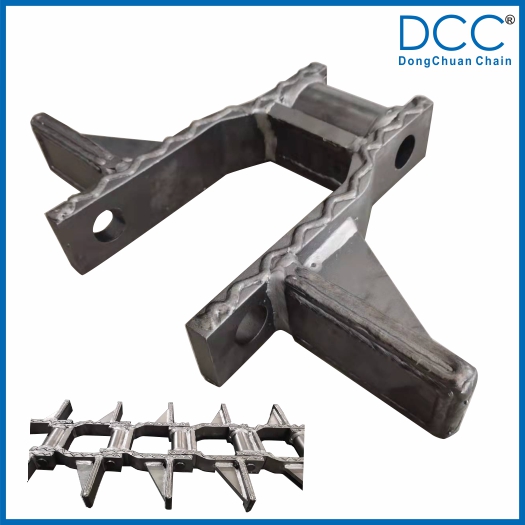
- K-style attachments: Extended plates welded to chain links for carrying wide products
- Slat attachments: Flat carriers that create a continuous surface between chains
- Flight attachments: Vertical plates that push bulk materials along conveyor troughs
- Cleats: Angled barriers that prevent product rollback on inclined conveyors
- Specialized fixtures: Custom brackets designed for unique product geometries
Attachments must meet material strength specifications to match chain capabilities. Each connection point can support loads up to the chain's rated working limit. Some attachments include quick-release mechanisms for simplified maintenance. The materials and dimensions always comply with applicable standards, guaranteeing worldwide compatibility with chain systems. This integration allows safe material transport across diverse industrial applications.
Note: The interaction between chains and attachments creates versatile material handling solutions, making industrial operations more efficient and adaptable to changing production requirements.
Types and Materials
Carbon Steel Grades
Manufacturers select carbon steel for welded steel chains because this material handles heavy loads, resists wear effectively, and provides excellent value. Carbon steel maintains its strength across wide temperature ranges, from -40°C to 200°C in industrial applications according to NACM chain standards. These characteristics make carbon steel the preferred choice for general industrial applications.
To satisfy strict quality requirements, carbon steel chains must meet national and international standards. Production occurs in certified facilities that verify every batch for proper chemical composition, mechanical strength, and dimensional accuracy. The steel's carbon content typically ranges from 0.15% to 0.35% maximum, with phosphorus limited to 0.040% maximum and sulfur to 0.050% maximum as specified in NACM welded steel chain specifications. Alloy additions like manganese or chromium improve specific properties. Heat treatment processes such as quenching and tempering at temperatures between 800°C and 900°C enhance the steel's durability and toughness. Quality control teams test sample links for tensile strength, ensuring chains can safely handle their rated loads.
Alloy Steel Options
Alloy steel chains serve applications requiring enhanced performance characteristics beyond what carbon steel provides. These materials incorporate elements like nickel, chromium, or molybdenum to improve specific properties. Grade 80 and Grade 100 alloy chains are heat-treated to achieve tensile strengths of 800 MPa and 1000 MPa respectively, as documented in ASTM A391 specifications. Nickel additions (minimum 0.40%) increase impact resistance for shock-loading applications. Chromium content enhances corrosion resistance in humid environments.
Manufacturers formulate alloy compositions based on application requirements. Mining operations might specify chains with 1-2% chromium for abrasion resistance. Food processing facilities could require stainless steel chains (typically 304 or 316 grade) that resist corrosion from moisture and cleaning chemicals. Each alloy type undergoes specific heat treatment to optimize its microstructure and mechanical properties.
Surface Treatments
Surface treatments extend chain life and improve performance in challenging environments. Hot-dip galvanizing applies a zinc coating that protects underlying steel from corrosion, making chains suitable for outdoor applications or humid conditions. The zinc layer thickness typically ranges from 45 to 85 microns, providing years of protection.
Powder coating creates a durable polymer barrier against moisture and chemicals. This treatment allows color coding for different chain specifications or safety zones. Black oxide coating provides mild corrosion resistance while maintaining precise dimensions for critical applications. Specialized treatments like nickel plating or chrome plating serve extreme environments where standard coatings would fail.
Tip: Surface treatment selection should match the operational environment. Indoor dry applications may need only basic oil coating, while marine or chemical processing environments require galvanized or stainless steel construction.
Manufacturing Quality Control
Chain manufacturing involves multiple verification steps to ensure consistent quality as outlined in ASTM standards for metals testing. Foundries begin with incoming material inspection, testing steel chemistry and physical properties before production. During forming operations, technicians monitor link dimensions using precision measuring instruments. The welding process receives continuous oversight, with operators adjusting parameters to maintain optimal fusion quality.
After welding, chains undergo several finishing steps. Workers remove weld flash and smooth rough edges through tumbling or grinding operations. Surface treatments are applied according to customer specifications. Quality inspectors then conduct final verification checks on finished chains.
The quality control process includes these key stages:
- Material certification: Verify steel meets composition requirements per NACM specifications
- Dimensional inspection: Confirm link size and pitch accuracy
- Weld quality testing: Sample testing using non-destructive methods
- Proof testing: Application of test loads per manufacturer specifications
- Surface finish verification: Coating thickness and adhesion checks
- Final documentation: Create certification packages for customer records
| Stage | Purpose | Result |
Material Inspection | Ensures correct composition | Consistent mechanical properties |
Link Forming | Creates precise geometry | Accurate sprocket engagement |
Weld Inspection | Verifies joint integrity | Reliable strength performance |
Proof Testing | Confirms capacity | Safe operational loads |
Documentation | Provides traceability | Quality assurance records |
Quality manufacturers' commitment to thorough inspection helps customers avoid operational problems. Reliable chains reduce maintenance costs and downtime while improving workplace safety. This expertise in welded steel chain production supports dependable industrial operations.
Tip: Customers should request material certifications and test reports when purchasing chains. This documentation confirms that products meet required safety and performance standards.
Industry Standards
NACM and ASTM Specifications
International standards establish requirements for welded steel chain dimensions, materials, and performance. NACM (National Association of Chain Manufacturers) specifications define the primary standards for welded steel chains used in industrial and commercial applications in North America. These specifications cover Grade 30 proof coil, Grade 43 high test, Grade 70 transport, Grade 80 alloy, and Grade 100 alloy chains. ASTM specifications such as ASTM A391 for Grade 80 alloy chain provide testing methods and minimum mechanical properties. DIN standards provide similar guidance for European applications. These specifications outline required tensile strength, proof load capacity, and dimensional tolerances.
Compliance with recognized standards ensures chains perform safely across their intended working range. Manufacturers document conformance through test reports and material certifications. When industrial operations specify standard-compliant chains, they ensure compatibility with existing equipment and established safety practices.
Standard Dimensions
Chain specifications include precise measurements for pitch, link diameter, and internal dimensions. These parameters ensure chains fit standard sprockets correctly and transmit loads efficiently. Common industrial pitches range from 1 inch (25.4mm) to 6 inches (152.4mm), with link wire diameters proportional to pitch size according to conveyor chain standards.
Standard specifications typically include:
- Pitch: Distance between chain links, ranging from 1" to 6" for industrial applications
- Wire diameter: Link material thickness, from 3mm to 32mm depending on capacity
- Inside length: Internal link dimension affecting sprocket compatibility
- Inside width: Lateral dimension determining attachment compatibility
- Breaking strength: Minimum load causing chain failure
- Working load limit: Maximum recommended operational load with safety factor (typically 4:1 to 5:1)
- Material grade: Steel specification defining chemical composition and heat treatment
Dimensional consistency across production batches ensures replacement chains function identically to original equipment. This standardization reduces inventory requirements and simplifies maintenance planning.
Practical Applications
Material Handling Systems
Welded steel chains enable efficient material movement through manufacturing facilities as documented in conveyor equipment standards. Production lines use chains to transport components between workstations, maintaining continuous flow through assembly processes. Overhead conveyors employ chains to move products through finishing operations like painting or coating. Workers depend on these systems to deliver materials at precise times, supporting just-in-time manufacturing strategies.
Heavy duty welded chain installations handle demanding applications like bulk material conveyors in mining operations. These systems move ore, coal, or aggregates across long distances, often exceeding 100 meters. The permanent welded construction prevents link separation in environments where repairs would be difficult and dangerous.
Steel Production
Welded steel mill chain serves critical functions in steel manufacturing facilities. Rolling mills use chains to transport hot steel slabs between processing stages. The chains must withstand extreme temperatures while maintaining dimensional stability for accurate material positioning. Specialized high-temperature alloys and heat-resistant coatings protect chains from thermal damage.
Continuous casting operations employ chains to move molds through the casting process. These applications demand precise chain pitch to maintain synchronization with other equipment. Any variation in chain dimensions would disrupt production and potentially damage expensive tooling.
Power Generation and Heavy Industry
Power plants utilize chains for coal handling systems, ash removal conveyors, and equipment positioning systems. These installations operate continuously, requiring chains with excellent wear resistance and minimal maintenance needs. Nuclear facilities specify chains meeting stringent quality and traceability requirements for safety-critical applications.
Tip: Application-specific chain selection ensures optimal performance and longevity. Consulting experienced conveyor chain manufacturers like DCC helps identify the most suitable products for demanding environments.
Identification & Maintenance
Identifying Quality Chains
Quality welded steel chains demonstrate specific characteristics that indicate reliable performance. Inspectors examine welds for complete fusion and smooth finish without porosity or cracks. They verify uniform link dimensions throughout the chain length. Quality chains display consistent surface finish free from excessive scale, pitting, or contamination. The links articulate smoothly without binding or excessive play.
Manufacturers mark chains with identification codes indicating size, grade, and production date. These markings help verify chains meet specified requirements. Inspectors measure link pitch using precision instruments to confirm dimensional accuracy. If chains show dimensional variations, uneven welds, or surface defects, they may not provide reliable service.
Tip: Purchase chains from established manufacturers with documented quality systems. Request material certifications and test reports to verify compliance with NACM specifications.
Regular inspection helps detect developing problems before they cause failures. Professional maintenance programs include periodic chain evaluation and documentation of wear patterns. Early identification of issues prevents unexpected downtime and reduces replacement costs.
Compatibility Verification
Compatibility checks confirm chains work correctly with existing sprockets and attachments. Maintenance personnel test chain engagement by manually rotating sprockets and observing smooth, even contact. Chains should seat fully in sprocket tooth profiles without binding or excessive clearance. Inspectors verify pitch matches sprocket specifications using measuring tools.
A verification checklist includes these items:
| Checkpoint | What to Verify |
Pitch accuracy | Matches sprocket tooth spacing |
Link articulation | Smooth movement without binding |
Sprocket engagement | Full contact across tooth profile |
Attachment fit | Proper clearance and alignment |
Manufacturer markings | Confirms specification compliance |
If chains fail compatibility checks, they should not be installed. Mismatched components cause accelerated wear, increased noise, and potential safety hazards. Using correct chains ensures reliable operation and extends equipment life.
Maintenance Requirements
Proper maintenance preserves chain performance and extends service life according to conveyor maintenance guidelines. Operators should implement lubrication programs appropriate for their operating conditions. Chains in dirty environments require frequent cleaning before lubrication to prevent abrasive contamination. Indoor applications with moderate loading might need lubrication every 500 operating hours, while harsh environments could require daily attention.
Lubrication reduces friction between links and sprockets, dissipating heat and preventing corrosion. Technicians apply lubricant to link bearing surfaces, ensuring penetration into articulation points. Excess lubricant should be wiped away to prevent dirt accumulation.
Inspection procedures should occur at regular intervals:
- Daily visual checks for unusual wear or damage in critical applications
- Weekly detailed inspection including measurement of wear and elongation
- Monthly documentation of chain condition and maintenance actions
- Annual replacement evaluation based on measured wear rates
Operators must monitor chain tension to maintain optimal performance. Excessive tension increases bearing loads and accelerates wear. Insufficient tension allows chain whip that damages equipment. Tensioning devices should provide adjustment capability throughout the chain's service life.
Note: Documented maintenance programs help track chain performance and predict replacement timing. This approach reduces unplanned downtime and optimizes maintenance budgets.
Common Problems and Solutions
Excessive Elongation
All chains experience gradual elongation as link bearing surfaces wear during operation. Normal wear rates depend on load, speed, lubrication quality, and environmental conditions. Excessive elongation occurs when chains stretch beyond acceptable limits, causing poor sprocket engagement and timing errors.
Monitoring elongation allows predictive maintenance before chains fail. Operators measure chain length over a specified number of pitches and compare results to original dimensions. Most applications should replace chains when elongation reaches 2-3% of original length. Continuing operation with excessively worn chains damages sprockets and increases failure risk.
Corrosion Damage
Rust and corrosion attack steel chains in humid, wet, or chemically active environments. Surface corrosion creates rough textures that accelerate wear and reduce chain strength. Deep corrosion pits cause stress concentrations that can initiate cracks. Prevention through proper material selection and surface treatment proves more effective than corrective action after damage occurs.
In corrosive environments, specify chains with appropriate protection. Galvanized chains serve outdoor applications exposed to moisture. Stainless steel chains resist chemical attack in processing industries. Regular cleaning and lubrication provide additional protection by preventing moisture and contaminant accumulation.
Unusual Wear Patterns
Abnormal wear indicates system problems requiring correction. One-sided wear suggests misalignment between chain and sprockets. Localized wear at specific links points to damaged or mismatched sprockets. Accelerated wear across the entire chain may result from inadequate lubrication, contamination, or overloading. Addressing root causes extends chain life and improves system reliability.
Wear pattern analysis helps identify problems:
- Edge loading: Indicates angular misalignment
- Tooth-side wear: Shows improper sprocket engagement
- Pin wear: Suggests inadequate lubrication
- Plate wear: Indicates abrasive contamination
Correcting alignment, improving lubrication, and controlling contamination resolves most unusual wear problems.
Replacement Guidelines
Industrial operators must recognize when chains require replacement to maintain safe, reliable operations. Worn or damaged chains compromise equipment performance and create safety hazards. Systematic evaluation helps determine appropriate replacement timing.
Replacement Criteria
Operators should consider chain replacement when observing these conditions:
- Elongation beyond limits: Chain stretch exceeding 2-3% of original length
- Visible cracks: Any crack in link material, regardless of size
- Severe corrosion: Deep pitting or material loss from rust
- Deformed links: Bent, twisted, or otherwise misshapen links
- Worn surfaces: Link material reduction creating excessive clearances
- Damaged welds: Cracks or separation at weld joints
Tip: Replace chains based on measured wear rather than arbitrary time schedules. This approach optimizes costs while maintaining safety.
Replacement Procedure
Chain replacement requires systematic execution to ensure proper installation and operation. Operators should follow these steps:
- System shutdown: De-energize and lock out equipment per safety procedures
- Tension release: Remove tension from existing chain using adjustment mechanisms
- Chain removal: Disconnect old chain and remove from equipment
- Inspection: Examine sprockets and guides for wear or damage
- New chain installation: Route new chain through system following manufacturer's guidelines
- Tension adjustment: Set initial tension per specification
- Alignment verification: Confirm proper alignment throughout chain path
- Break-in operation: Run system under light load initially to seat chain
- Final adjustment: Re-check and adjust tension after break-in period
- Documentation: Record installation details and establish maintenance baseline
| Step | Action Required | Why It Matters |
Shutdown | Lock out energy sources | Prevents accidents |
Remove Old Chain | Disconnect and extract | Clears installation path |
Inspect Components | Check sprockets/guides | Identifies related wear |
Install New Chain | Route per specifications | Ensures correct operation |
Adjust Tension | Set to proper specification | Optimizes performance |
Verify Alignment | Confirm proper geometry | Prevents premature wear |
Break-in | Initial light-load operation | Seats chain on sprockets |
Final Adjustment | Re-tension after settling | Maintains optimal function |
Document | Record details | Supports future maintenance |
Note: Only qualified maintenance personnel should perform chain replacement. Proper tools and safety equipment are essential for safe execution.
Replacement Frequency
Chain replacement intervals vary significantly based on application severity and maintenance quality. Light-duty conveyors in clean environments might operate for several years before requiring replacement. Heavy-duty applications in abrasive conditions could need annual or more frequent replacement.
Predictive maintenance programs track wear rates to forecast replacement timing accurately. This approach prevents unexpected failures while avoiding premature replacement of serviceable chains. Documented wear measurements support data-driven replacement decisions.
Operators should prioritize safety over cost considerations. When chain condition is questionable, replacement provides greater security than continued operation. Reliable chains support productive operations and protect valuable equipment from damage.
Conclusion
Welded steel chains serve as essential components in industrial operations where strength, reliability, and durability determine success. Understanding chain types, proper selection criteria, and maintenance requirements enables facilities to maximize equipment performance and operational lifespan.
- High-quality materials and precision manufacturing create chains that resist wear and environmental stress
- Regular maintenance preserves chain function and prevents premature failure
- Proper selection matching application requirements optimizes safety and efficiency
Experts recommend sourcing certified chains from established conveyor chain manufacturers and implementing systematic maintenance programs. The permanent welded construction provides inherent advantages in demanding applications. By matching chain specifications to actual operating conditions and maintaining chains properly, operations achieve reliable performance and strong return on investment.
Whether applications involve heavy duty welded chain in mining operations, welded steel mill chain in metal processing, or standard welded steel chain in manufacturing systems, proper selection and care ensure optimal results. For questions about chain selection or technical support, industrial operations should consult with experienced suppliers who understand application requirements and can recommend appropriate solutions.
FAQ
What makes welded steel chain different from other chain types?
Welded steel chain features permanently fused links rather than mechanical connections. This construction eliminates weak points found in assembled chains, providing superior strength and reliability for heavy-duty applications per NACM standards.
How can maintenance personnel identify worn chains?
Inspectors measure chain elongation over a set number of links and compare to original specifications. They also examine links for cracks, corrosion, deformation, or excessive wear. Elongation beyond 2-3% typically indicates replacement is needed.
Are all welded steel chains the same size?
No. Chains are manufactured in various pitch sizes and wire diameters to match different load requirements according to conveyor chain standards. Common industrial pitches range from 1 inch to 6 inches, with proportional link dimensions. Standardized sizes ensure sprocket compatibility.

