


Forged chain vs cast chain: what is the difference?
Forged chain is worked into shape while solid; cast chain is poured into a mold and solidified. That difference changes grain structure, fatigue behavior, traceability, and cost. This guide compares both routes across strength, applications, standards, and lifecycle cost for industrial conveying duty.
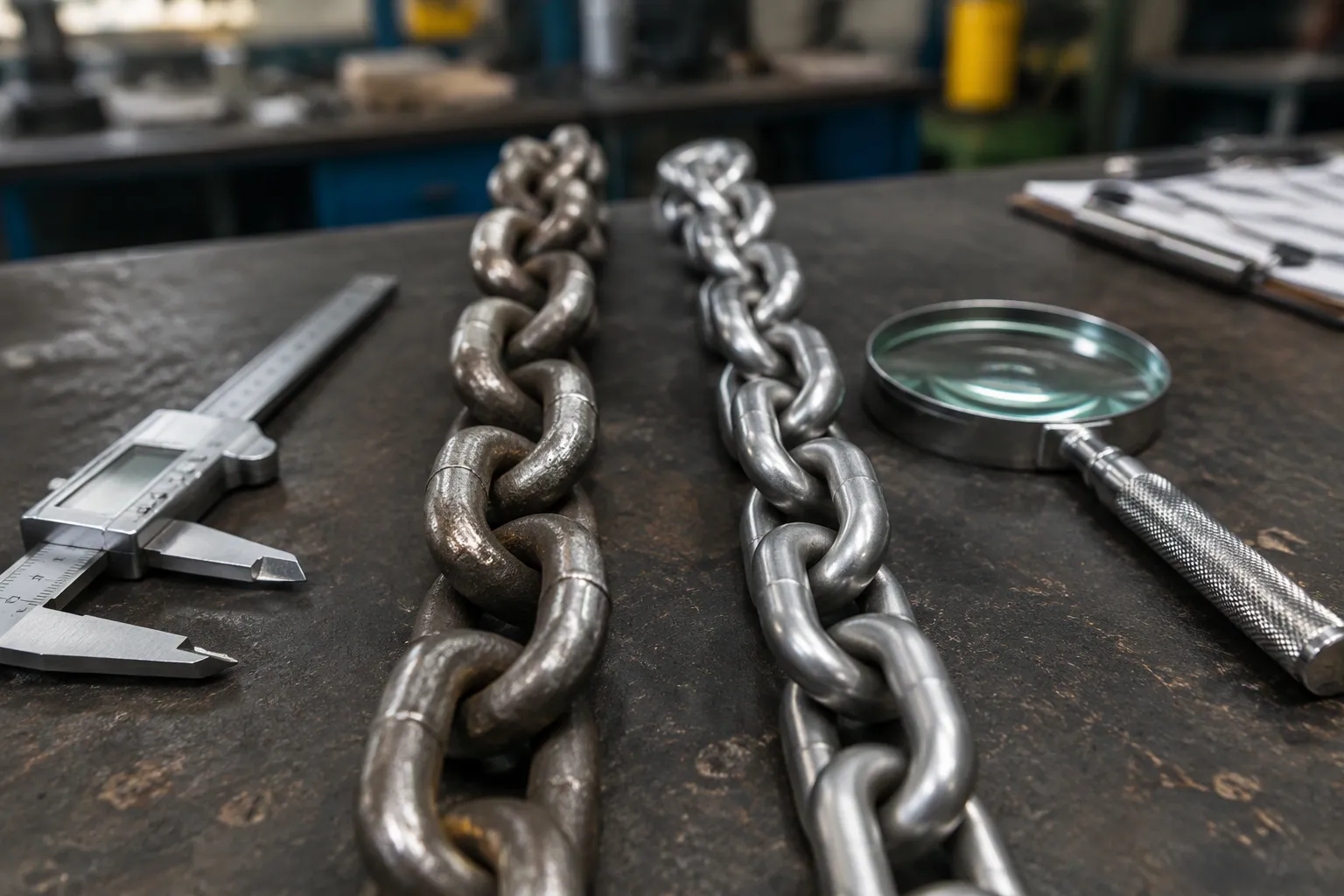
Key Takeaways
Forged chain is worked hot under compressive force; cast chain is produced by pouring metal into a mold.
Forging refines and aligns grain flow, while casting can leave coarser grains and shrinkage or gas porosity.
General comparison data put forged parts about 26% higher in tensile strength and about 37% higher in fatigue strength, but material grade and process control still decide results.
Forged chain is preferred for cyclic, shock, and abrasive duty; cast chain earns its place where shapes are complex or budgets are tight.
Load ratings and batch-linked test documents matter when capacity must be recorded.
Ask for the right document: a mill certificate covers steel, a proof-test record covers an assembly, and ISO 9001 covers the supplier's process.
Compare replacement frequency and downtime, not only the purchase price.
DCC supplies both forged and cast chain families, so selection is a duty decision rather than a brand decision.
How forged chain is made
Heating and shaping
What a forged chain is starts with a length of metal bar stock. The bar is heated until soft and workable, then moved under a hammer or press. Compressive force pushes the material into the shape of the link or die cavity. Each blow or stroke works the metal rather than cutting it away, so the part keeps its mass throughout the operation. The shaping step also rearranges the internal structure, and that rearrangement is the real advantage of the method.
Grain flow advantage
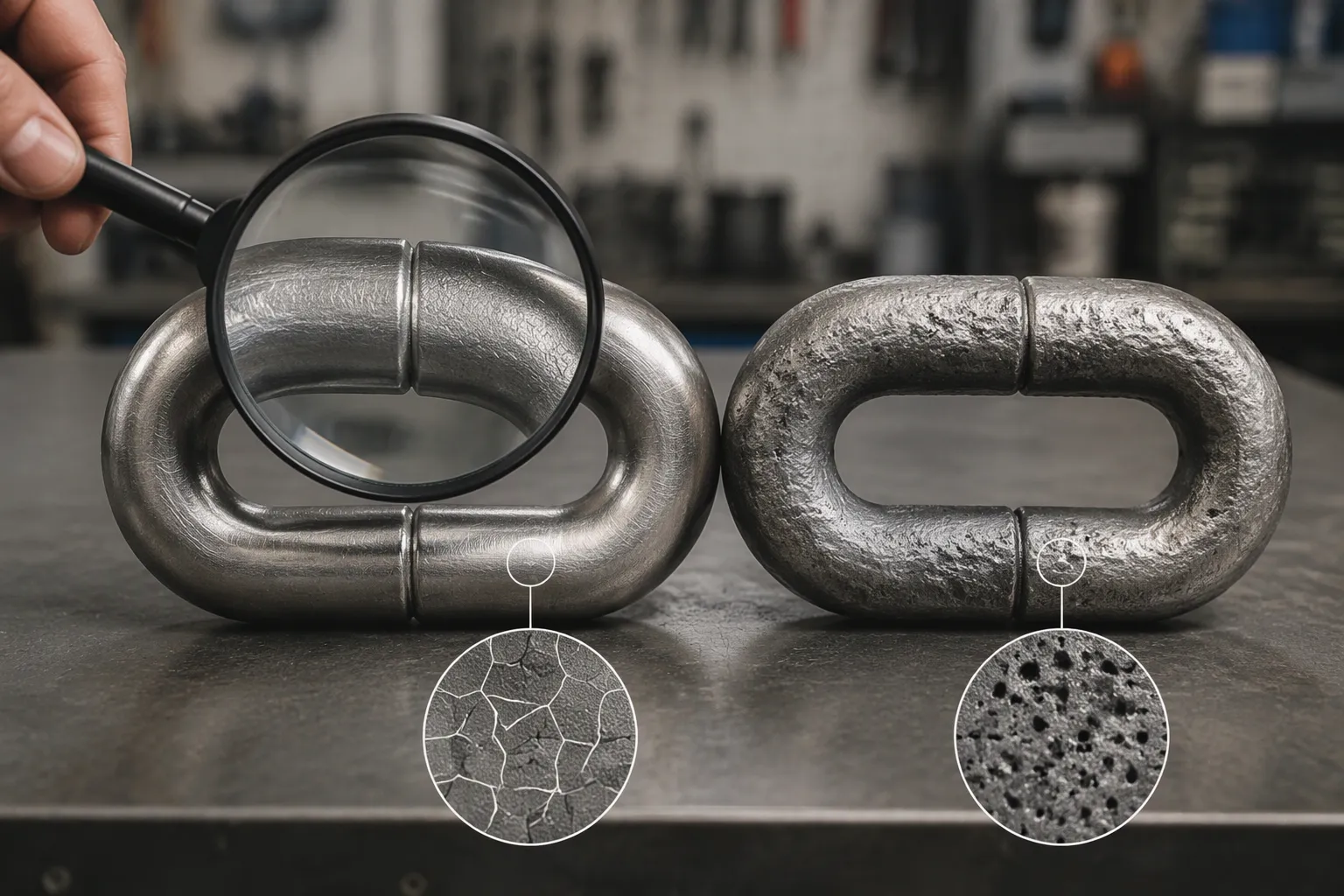
Metal has an internal grain structure, much like fibers in wood. Forging works the metal while hot and soft, stretching and aligning the grains along the shape of the part. A forged link gets a continuous, fine grain structure that follows its curves, leaving no shrinkage cavities or gas pockets of the kind casting can develop. That structure supports strength and wear resistance in service, so a forged chain starts with a sound internal build rather than one that must be screened for hidden voids.
Finishing and heat treatment
Shaping is only part of the job. Flash and excess material are trimmed, edges are cleaned, and link geometry is checked against the drawing. Controlled heating and cooling then adjust hardness and toughness: harder for wear resistance, tougher for impact absorption. Final inspection checks dimensions, surface condition, and hardness before the chain is assembled and shipped. Each stage builds on the last, producing a part with a sound structure from the inside out. DCC's forged chain and cardan chain range follows this route with custom options for non-standard drive layouts.
How cast chain is made
Pouring into molds
Casting takes a different route. Metal is melted in a furnace, then poured into a mold shaped like the finished link. The mold may be sand, metal, or another refractory material, often produced from a pattern. The pour must fill every corner of the cavity without turbulence that could trap air, so a steady stream and a well-vented mold design both matter. Once full, the metal cools and hardens into the mold shape.
That approach has a clear strength: shape freedom. Complex geometries, hollow sections, and intricate profiles are easier to pour than to hammer, which is why cast chain serves specialty and lighter-duty roles. The key features of cast chains show how the route supports non-standard link forms.
Solidification and grain
Liquid metal solidifies from the outside inward, and grains grow in the direction heat leaves the mold, typically producing a coarser grain than forging. General foundry literature puts cast grain size around 50 to 200 microns and porosity around 0.1% to 2%; these are broad process-dependent ranges, not guaranteed values for any one chain grade. Shrinkage occurs as metal contracts on cooling, and dissolved gases can form pockets. Good foundry practice keeps these defects controlled within acceptance limits.
Finishing and inspection
Raw castings rarely ship as-poured. Gates, runners, and flash are removed, then surfaces are cleaned by shot blasting or grinding. Machining follows where holes, pins, or mating surfaces demand tight tolerances, and heat treatment adjusts hardness and toughness much as it does for forged parts. Inspection confirms dimensions, surface condition, and hardness. Mold quality, pour temperature, cooling rate, and finishing discipline all influence the final part, and the cast steel chain specifications and standards guide sets out how buyers specify the result.
Forged chain vs cast: performance
Strength and fatigue life
The manufacturing method leaves a measurable fingerprint on mechanical properties. Widely cited comparison data, drawn from a University of Toledo study of forged steel and ductile cast iron crankshafts, put forged parts about 26% higher in tensile strength and roughly 37% higher in fatigue strength, which translates to about six times longer fatigue life under cyclic loading. Those figures are useful directionally, but they come from crankshaft coupons rather than chain links, so they should not be read as a guaranteed chain rating.
The mechanism is still relevant. Internal voids and coarse grain boundaries are where fatigue cracks start, and fewer discontinuities mean fewer initiation sites. That is why the fatigue gap is often larger than the static strength gap, and why duty cycle matters more than a single tensile number. DCC supplies both routes and treats the comparison as a duty question rather than a universal ranking.
Impact and wear resistance
Impact loading punishes internal defects. A sudden shock sends stress waves through a link, and voids or coarse grains act as stress concentrators. A forged link absorbs that energy through a sound, continuous structure. A cast link can perform well under steady load but has less margin when shock arrives. Wear resistance follows a similar logic: abrasion removes surface material, and the rate depends on hardness and structural uniformity. Heat treatment sets hardness in both types, while the forged part starts from a cleaner base, so the treated structure stays more consistent through the section.
Load ratings and traceability
Buyers who must document capacity need a published figure. Forged chain products commonly carry quantifiable working load limits and test reports tied to a heat number and production batch, while cast or malleable equivalents often publish less detail. Batch-linked documents let a buyer trace a shipment to its production record, which supports audits, maintenance planning, and failure investigation. For conveyor and engineering chain, the discussion of welded steel chain load capacity and testing standards explains what a load figure and a test record actually establish.
The table below summarizes the comparison across the main performance dimensions. Values are qualitative or literature-based, not a datasheet for a specific chain.
| Property | Forged chain | Cast chain |
|---|---|---|
| Tensile strength | About 26% higher | Baseline |
| Fatigue strength | About 37% higher | Baseline |
| Fatigue life | Roughly six times longer | Baseline |
| Grain structure | Fine and continuous | Coarser, 50–200 microns |
| Internal porosity | No casting-type voids | 0.1%–2% typical |
| Impact resistance | Strong margin under shock | Adequate for steady loads |
| Wear resistance | Consistent through section | Depends on casting soundness |
| Published load rating | Commonly available | Often not published |
Mechanical properties are normally verified on a tensile testing machine under a standard method such as ASTM E8. Both chain types serve industrial conveying needs; the right question is which profile matches the duty. Forged chain suits cycles where fatigue, shock, and abrasion dominate. Cast chain suits moderate loads, complex shapes, and cost-sensitive programs.
Ask for the Test Report Behind the Rating
Share duty, pitch, and attachment details to receive a chain proposal with the relevant load and batch documents.
Application fit: where each works best
Load types and duty cycles
Static load is the simplest case. A chain holding steady tension at rest or constant speed sees little variation, and both product types handle it when the rating matches. Cyclic load changes the picture: every start, stop, and reversal adds a stress cycle, and fatigue life becomes limiting. Shock load is harshest, since sudden impacts from dropped loads, jams, or abrupt starts send stress waves through the link.
Duty cycle matters in practice as well. A chain running eight hours a day, five days a week accumulates cycles far faster than one used intermittently. The heavier the duty and the more variable the load, the more the fatigue profile decides service life. The 2026 checklist for selecting industrial conveyor chains covers the same starting questions, and the X678 chain guide shows how a specific chain family is matched to conveying duty.
Environments and conditions
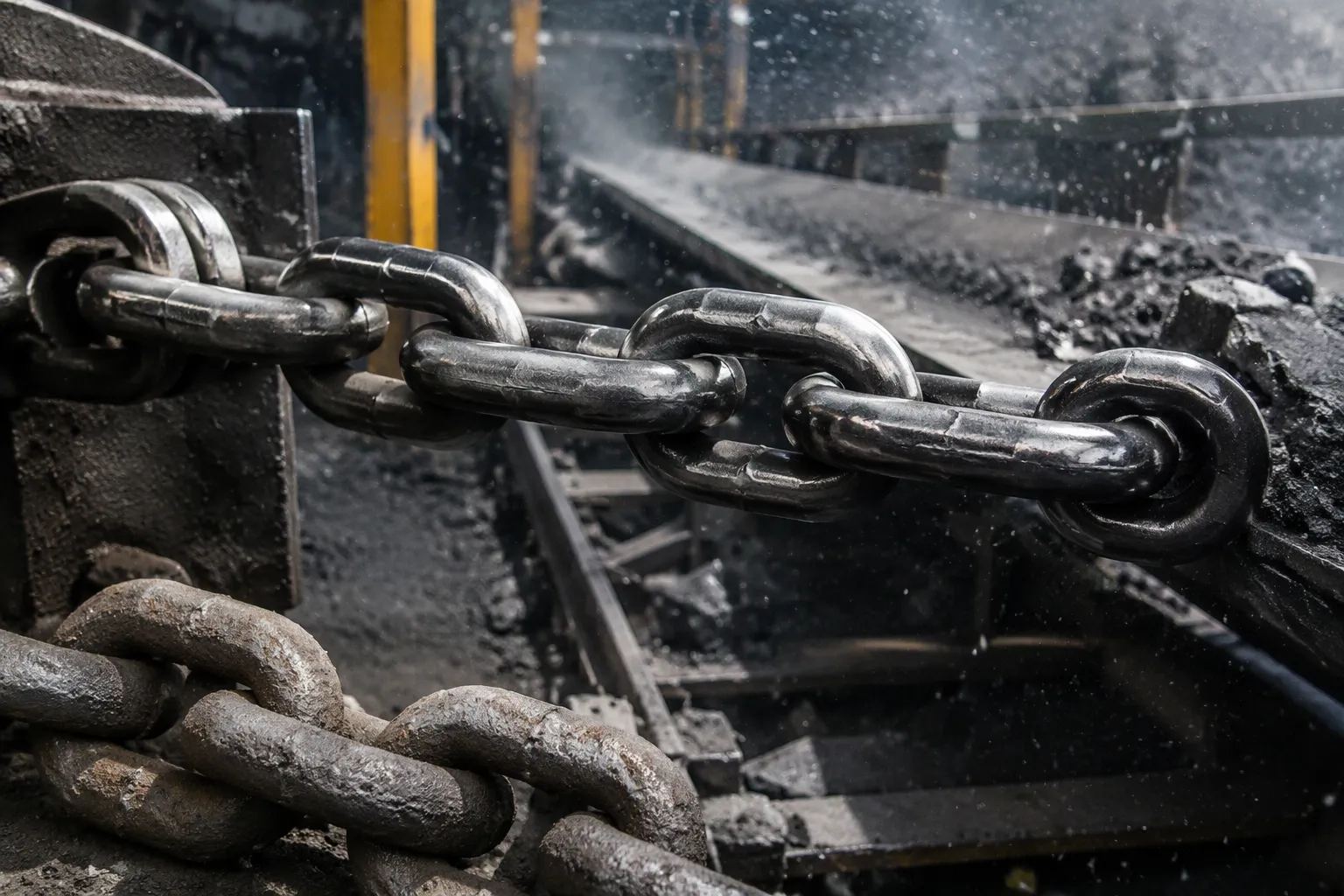
Abrasive environments grind at moving surfaces: dust, grit, and mineral fines work into pin and bushing clearances. Both product types can be heat treated, and a sound casting performs reliably in moderate abrasive service; severe abrasion with shock asks for the cleaner internal structure of a forged part. Corrosive conditions call for material selection more than manufacturing method, so alloy and surface protection should match the chemical exposure.
Temperature adds another dimension. High heat can soften a chain and reduce capacity, while cold can make it brittle; grade and heat treatment decide how well either type holds up. Contamination is related: food processing and clean-room equipment need chains that shed little debris and clean easily, and smooth finishes plus tight process control help in both cases. For hot processes such as kilns or furnaces, DCC's chains for the metallurgy industry illustrate how grade and treatment are specified for the environment.
Shape complexity and customization
Shape freedom is casting's home ground: liquid metal fills a mold of almost any profile, so hollow sections and non-standard geometries are easier to pour. Forging works best with link forms that suit a die and press, with standard pitches and high-volume runs spreading tooling cost across production. Customization is not limited to casting, though. A capable manufacturer can co-design application-specific links to a customer blueprint, and forged chain can be adapted to unusual duty when volume justifies the tooling. Many plants run both routes, matching each chain to its station.
For the neighbouring welded-steel option, the comparison of forged link chains with welded steel chains sets out a third route, and the strengths and applications of welded chains show where that family fits.
Standards, testing, and compliance
Common chain standards
Standards give buyers a shared language. ISO 610:1990 covers high-tensile round-link steel chains for chain conveyors and coal ploughs, not general roller chain dimensions. ISO 10823:2004 gives selection guidance for roller chain drives made up of chains and sprockets conforming to ISO 606. ISO 606 is the dimensional standard for short-pitch transmission roller chains and attachments. Naming the correct standard matters: a round-link mining chain and a precision roller chain are specified under different documents.
ASTM and ASME codes and standards address lifting and rigging components, including proof-test requirements for chain slings, while API standards govern equipment used in oil and gas service. Buyers in metallurgy, sugar, and palm oil processing often work from a mix of national standards and internal specifications. State the standard in the purchase order rather than assume it, and name the target market explicitly.
What test reports show
A test report turns a claim into evidence. A useful report identifies the heat number and production batch, records the material grade, and lists mechanical results such as tensile strength and hardness for that batch. Dimensional checks and visual findings usually appear as well. A certificate with no batch reference proves far less, even when the numbers look good.
Matching certificates to use
Certificates come in different scopes. A mill certificate covers the steel itself; a proof-test certificate covers the finished assembly under a defined load; a quality management certificate such as ISO 9001 covers the supplier's process controls rather than any single part. Ask what each document proves, then check whether that proof matches the requirement. DCC reports ISO 9001 and API certification and states that more than 40% of annual output value comes from non-standard custom products, which makes drawing control and batch records especially relevant for bespoke links.
Cost: upfront vs lifecycle
Initial purchase price
Forging adds heating steps, press time, die tooling, and heat treatment, so a forged chain usually carries a higher unit price. Casting reaches a finished shape in fewer operations, and a complex or one-off link shape often needs a mold rather than a forging die, which is cheaper in low volumes. Buyers with standard pitches and high volumes spread die cost across a long run and the gap narrows.
Maintenance and replacement
Replacement frequency drives the lifecycle side of the ledger. A chain that fails early forces a shutdown, a new order, and labor for the swap, and those costs often exceed the price difference between the two routes. Wear matters too: a chain that wears slowly holds pitch and keeps mating sprockets in good condition, while a fast-wearing chain can take the sprocket with it.
Total cost of ownership
A worked example makes the math concrete. Suppose a heavy conveyor needs one chain replacement every year with a cast product: over five years that is five replacements, five shutdowns, and five sets of labor hours. If a forged alternative lasts the full five years on one installation, the buyer pays once but avoids four replacement events. The reverse case is equally valid: a light-duty line running intermittently may never approach the fatigue limit of either product, so the cast chain delivers adequate service at a lower entry price. The apron conveyor chain manufacturer comparison illustrates how heavy-duty stations are evaluated in practice.
Estimate Replacement Cost Before Comparing Quotes
Share duty hours and the current replacement interval to compare total spend over the planned service life.
Three chain families recur in the comparison above; each linked page lists the constructions and typical duties relevant to a specification.

Forged Chain
Forged links with continuous grain flow, used where cyclic loading, shock, and abrasion decide service life.
View Product
Cast Chain
Cast links for non-standard geometries and moderate duty, specified by grade and heat treatment.
View Product
Conveyor Chain
Engineering and conveyor chains for metallurgy, sugar, palm oil, and general material handling lines.
View ProductHow to choose: a buyer's checklist
Define load, speed, environment
Start with load type. Steady tension at constant speed is the easiest case, and both product types serve it well when the rating matches. Cyclic loading changes the math because every start and stop adds a stress cycle; shock loading is harshest because impacts concentrate stress at internal voids and coarse grain boundaries. Speed raises the number of cycles per hour and shortens the fatigue clock. Name the worst condition the chain will meet, not the average one: a chain specified for the average will fail at the peak.
Confirm standards and documents
Name the standard in the purchase order and state the target market. Match each document to its purpose: a mill certificate covers steel, a proof-test record covers an assembly under load, and an ISO 9001 certificate covers process control. A certificate with no batch or heat reference is far less useful, even when the numbers look good. Ask for the test report before the order is placed, not after a failure.
Compare lifecycle cost
Estimate replacement frequency for the actual duty cycle, then count shutdowns and labor for each event. A heavy conveyor replacing a cast chain yearly faces five events over five years; a forged chain with roughly six times the fatigue life may last the full period on one installation. Weigh the premium against avoided events rather than the sticker price. In light intermittent duty, the cast route can be the economical answer. Match the profile to the station and the cost comparison becomes straightforward: forging shapes hot metal under force, casting pours it into a mold, and that single difference sets grain structure, fatigue behavior, documentation, and cost.
FAQ
Is a forged chain always stronger than a cast chain?
Not always. Material grade and quality control decide real results. General forging versus casting data show about 26% higher tensile strength and roughly 37% higher fatigue strength for forged steel, but a well-made casting can serve moderate loads reliably in the right grade.
How much longer does a forged chain last under repeated loading?
Widely cited comparison data put forged fatigue strength about 37% higher, translating to roughly six times longer fatigue life under cyclic loading. The source is forged steel versus ductile cast iron crankshaft testing, so treat the figure as directional rather than a chain-specific warranty.
Why do cast chains often lack published load ratings?
Casting reaches a shape in fewer operations, and many cast or malleable products ship without a stated working load limit. Forged chain products more commonly publish quantifiable ratings. Buyers who must document capacity should confirm the figure before ordering.
Which standards should a chain purchase order name?
Name the standard explicitly. ISO 610 covers high-tensile round-link chains for conveyors and coal ploughs, ISO 606 covers roller chain dimensions, and ISO 10823 gives roller chain drive selection guidance. ASTM and ASME documents address lifting components and proof tests, and API standards cover oil and gas service.
What does a chain test report actually prove?
A useful report ties results to a heat number and production batch, and records material grade, tensile strength, and hardness for that batch. A certificate with no batch reference proves far less, even when the numbers look good.
Can a forged chain be customized for an unusual link shape?
Yes, within limits. Forging suits link forms that fit a die and press, and tooling cost spreads across the run. Complex or one-off shapes are easier to cast. Volume and geometry decide which route makes sense.
When is a cast chain the better economic choice?
Cast chain wins on initial price and shape versatility. A light-duty line running intermittently may never approach the fatigue limit of either product, so the lower entry price delivers adequate service and the lifecycle savings of forging never appear.
How do I compare total cost rather than sticker price?
Estimate replacement frequency for the actual duty cycle. A heavy conveyor replacing a cast chain yearly faces five events over five years; a forged chain with roughly six times the fatigue life may last the full period on one installation. Weigh the premium against avoided shutdowns and labor.
References and Notes
ASTM E8 tensile testing of metallic materials — reference for reported tensile and hardness values (astm.org, accessed 2026-11-24)
ASME codes and standards catalogue — reference for lifting component and proof-test requirements (asme.org, accessed 2026-11-24)
API standards programme — reference for oil and gas service requirements (api.org, accessed 2026-11-24)
Data notes: the 26% tensile, 37% fatigue strength, and six-times fatigue life figures come from a University of Toledo comparison of forged steel and ductile cast iron crankshafts, not from chain-link testing. Grain size of 50 to 200 microns and porosity of 0.1% to 2% are broad general foundry ranges, not grade guarantees. ISO 610 covers round-link chains for conveyors and coal ploughs; ISO 10823 is roller chain drive selection guidance; the roller chain dimensional standard is ISO 606.
Internal links: all original links pointing to www.dcchains.com are preserved with anchors matched to each target page.

