


Comparing Steel Detachable and Roller Chains for Bucket Elevators
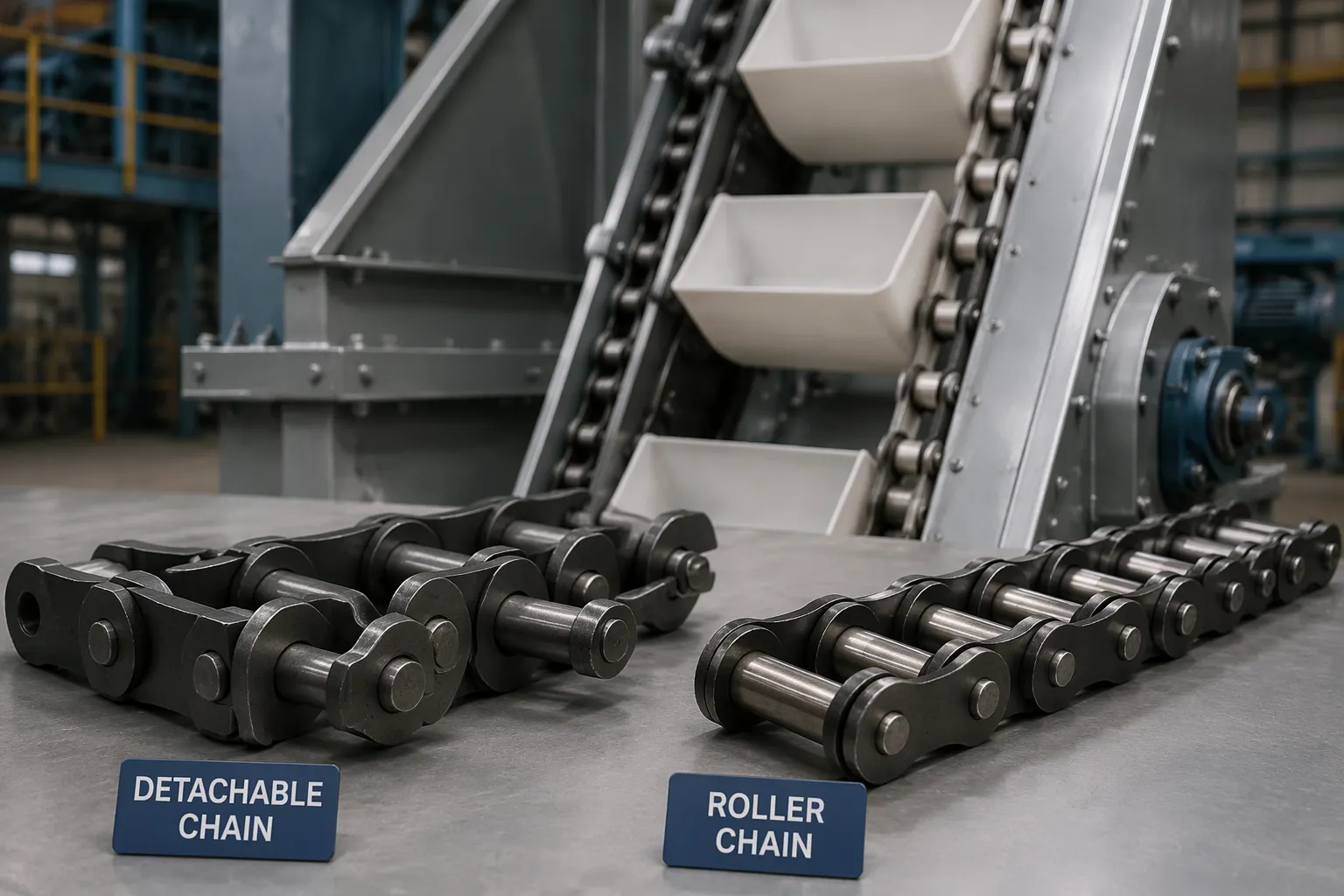
Formed-link detachable chain and pin-and-bushing roller chain, shown against a bucket elevator leg.
Steel detachable chain and roller chain differ in joint design, and that single difference decides load rating, wear path, speed limit, and cost per hour of bucket elevator service.
Neither steel detachable chain nor roller chain suits every bucket elevator job. The right elevator chain depends on the material, load, speed, environment, and budget you have. A direct comparison shows that each design has its own strengths. Engineers and maintenance managers should understand both chain types before they specify or buy.
Four chain selection criteria guide the decision: technical performance, application fit, regulatory compliance, and lifecycle cost. This guide gives procurement professionals and plant teams a practical path through each factor. It pairs objective data with field-tested guidance. Readers can then match a chain to their duty conditions with confidence.
Key Takeaways
Pick the right chain by matching it to your material, load, speed, environment, and budget.
Steel detachable chains work well for slow, heavy, rough, or hot jobs.
Roller chains work well in systems that run faster, stay cleaner, and need precise control.
Check the load limit and speed limit for your chain and sprocket setup.
Think about the full cost over the life of the chain. This includes setup, upkeep, and time lost when the system is down.
Pick the right chain material for your site: carbon steel works for dry, heavy-duty jobs, and grade 304 versus grade 316 stainless chain is the choice that matters in wet or corrosive places.
Check the chains often for wear, and replace them when they stretch or break down frequently.
Plan ahead for sprocket changes and tooling when you switch chain types.
Technical Performance Comparison
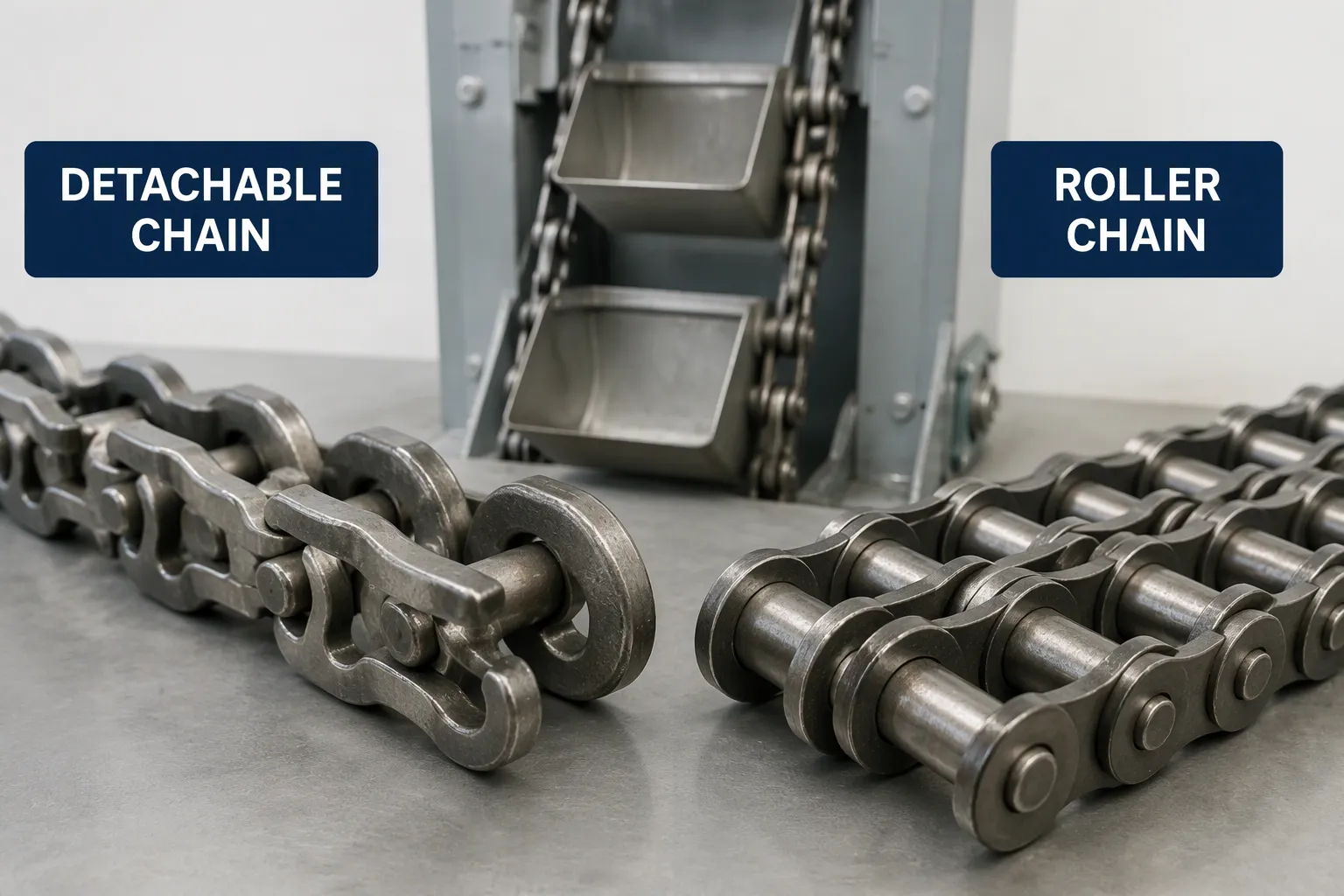
Joint geometry at a glance: detached hook links on the left, pin-and-bushing roller links on the right.
Strength and Load Capacity
Tensile Ratings and Working Loads
The two designs carry load in different ways. Steel detachable chain uses interlocking formed steel links. Workers can take these links apart and put them back together at certain points without pins and bushings, because the end bar of one link bears inside the hook of the next, the geometry that the dimensional standard for detachable and pintle chain fixes for interchangeability. Roller chain uses pins and bushings to bend and move. Each pin carries the full tension of the strand, and each bushing spreads that force across the plate holes. Bushed roller patterns such as the 81X steel-bushed roller chain apply the same principle at a fixed ANSI pitch.
This difference shapes the tensile rating of each type. A detachable link spreads stress across a wide formed hook, so the rated strength depends on hook shape and plate thickness. A roller chain focuses stress at the pin and plate joint. Buyers should compare published tensile ratings on the same basis. Some catalogs list ultimate tensile strength, and others list the working load. The working load is the number a designer should use, and it usually sits well below the ultimate rating to leave a safety margin.
Working load capacity also depends on strand count. Detachable chain comes in bush or small roller setups, in single or twin-strand setups, for bucket elevator service. A twin-strand setup shares the load across two strands and raises the usable working load for a given pitch. Engineers should confirm the rating for the assembled strand pair, not just one chain.
Engineering class chains generally last longer than standard roller chains. The gain comes from stronger materials, tighter tolerances, better heat treatment, and heavier construction. An engineered chain drive built to these standards carries a higher working load for the same pitch than a light-duty option.
Shock Load Behavior
Bucket elevators rarely run under steady load. A bucket digs into a pile, a lump jams under a boot pulley, or a startup jerks the strand from rest. These events send shock load through the chain. Detachable chain handles shock well in one way. The formed hooks flex and soak up some of the peak. The same flexibility limits fatigue life under repeated reversing stress. Roller chain acts differently. Pins and bushings resist steady tension well, but a sharp shock can brindle a pin or crack a bushing. Heavy-duty agricultural patterns such as the CA-type series address this with thicker side plates, solid rollers, and stronger pins, which raise shock resistance without changing the basic roller layout.
Wear Resistance and Durability
Wear Mechanisms in Abrasive Service
Abrasive dust attacks every moving surface. In a roller chain, grit works between the pin and bushing and grinds the bearing surface. In detachable chain, grit wears the hook contact faces. Both types lose material, and both stretch as a result. The wear path differs, so the inspection method differs. Maintenance teams should check pin and bushing clearance on roller chain and hook engagement depth on detachable chain, and a written engineering chain maintenance schedule keeps that routine from slipping. Hardened pins, solid chain rollers, and heat-treated plates slow the wear rate in either design.
Elongation and Fatigue Life
Elongation is the real limit on chain life. A worn chain no longer matches its sprocket pitch, and the mismatch speeds up wear on both parts. Roller chain stretches mainly through pin and bushing wear. Detachable chain stretches through hook wear and deformation. Fatigue life follows the same pattern. Roller chain fails at the pin under cyclic tension. Detachable chain fails at the hook or plate. Most causes of industrial roller chain failure trace back to this stretch, whether the joint is a hook or a pin. An engineered chain with controlled heat treatment resists both failure modes longer than a standard chain.
Speed and Operating Smoothness
Chain Speed Limits by Type
Roller chain types generally run at higher speeds. The pin and bushing joint bends smoothly, and the rolling contact keeps friction low at speed. Detachable chain suits lower speeds. The hook joint slides rather than rolls, and sliding contact makes heat and wear at high speed. Engineers should check the manufacturer's speed limit for the specific pitch and strand count. A chain drive pushed past its rated speed will wear fast, whatever the type.
Noise and Sprocket Engagement
Engagement quality drives noise. A roller chain seats into the sprocket with a rolling action, and a well-aligned engineered chain drive runs quietly. Detachable chain engages with a sliding hook contact, which can be louder at speed. Alignment, sprocket condition, and lubrication affect noise more than chain type alone. Teams should check sprocket wear before blaming the chain.
Two elevator chain families cover the designs described above, and their published ratings give a realistic sense of the size range involved.

Industry Steel Forged Bucket Elevator Conveyor Roller Chain
Forged alloy steel elevator chain with single, double and multi-row options, rivet, spring clip or threaded ends, and minimum tensile strengths from 128 kN to 450 kN across the published NE and NP sizes.
View Product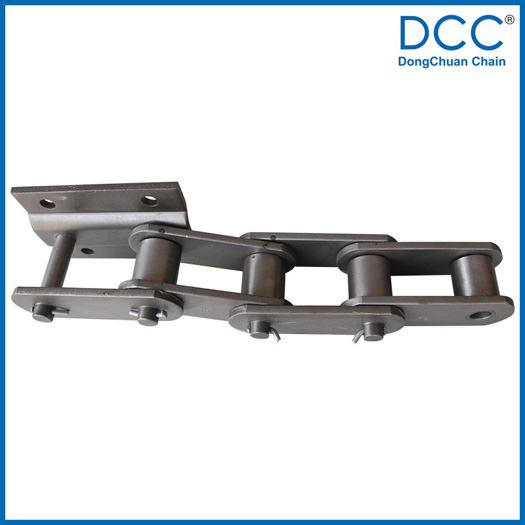
55 Series Bucket Elevator Chain
Heavy-duty elevator chain in RU95, RU150 and RU200 sizes at 180 mm pitch, rated 950 kN to 2,000 kN minimum tensile strength for high-capacity vertical conveying.
View ProductApplication Fit by Material and Elevator Type
Abrasive and High-Temperature Materials
Granular and Friable Bulk Solids
Fragile bulk solids need gentle handling. Steel detachable chain gives a smooth, low-impact ride that cuts material breakage. This design also holds more capacity per chain length, which fits high-volume bulk materials. Grain, pellets, and similar friable products do better with this gentler motion. Abrasive solids like sand, clinker, and ore need hard, wear-resistant surfaces instead. Both chain types can handle abrasive duty when the pins, rollers, and plates have proper heat treatment.
Hot and Wet Duty Conditions
Heat changes the material rules. Standard carbon steel loses strength as temperature rises, and lubricants break down faster. Cement kiln dust, foundry sand, and hot ash push chains toward heat-treated alloy construction, which is why chains built for metallurgy duty are specified by temperature and abrasion rather than by pitch alone. Wet duty adds a second stress. Moisture attacks plain steel surfaces and speeds wear at every joint. Chains with corrosion resistance treatments hold up better in humid or washed service. Buyers should confirm the rated temperature range before specifying any chain for hot or wet duty.
Elevator Configuration Factors
Discharge Style and Run Length
Centrifugal discharge elevators run buckets fast and throw material clear of the casing. Continuous discharge elevators move buckets slowly and tip material gently. Speed drives the chain choice here. Roller chain suits the higher speeds of centrifugal designs, a trade-off that the industrial roller chain and engineering class chain comparison sets out in detail. Detachable chain fits the slower, gentler continuous style. Long center-to-center distances add another factor. A long run multiplies the total chain weight and the working load on each strand, so engineers should size the chain for the full run, not just the bucket payload.
Casing and Sprocket Constraints
Casing size limits sprocket diameter and chain pitch. A tight casing may rule out large-pitch chain and force a compact design. Sprocket tooth count and hub space also limit the choice. Teams should check that the selected chain seats correctly on the available sprocket before ordering. A mismatch here causes rapid wear and early failure.
Operating Environment
Dust, Corrosion, and Washdown
Dust is the normal condition in most bucket elevators. Fine grit gets into every joint and grinds the bearing surfaces. Washdown adds water to the mix, and water plus dust forms an abrasive paste. Corrosion resistance becomes critical in food plants, chemical sites, and coastal installations. Stainless steel or coated chain reduces attack in these settings. Sealed or well-lubricated joints slow grit entry in dusty service.
Indoor versus Outdoor Service
Indoor service keeps temperature and moisture fairly stable. Outdoor service exposes the chain to rain, humidity swings, and ultraviolet light. Outdoor elevators need better corrosion resistance and more frequent inspection. Cold climates also test chain toughness at low temperatures. Buyers should match the chain material and surface treatment to the actual site conditions, not to a generic catalog rating.
Matching a Chain to Your Material, Speed and Casing
Send the conveying duty, pitch and sprocket details, and the range can be checked against published ratings before an order is placed.
Regulatory Compliance and Safety Standards
Industry Standards and Certifications
Chain and Conveyor Standards
Before you order, find out which standards a supplier builds to. ISO 9001 covers quality management. It shows the factory follows written process control. API specifications are written for severe service and are quoted by suppliers working in oilfield and heavy industrial duty. Engineering class chain and conveyor chain designs often follow national or international size standards, which is how a replacement chain seats correctly on a standard sprocket. For detachable chain the dimensional reference is ASME B29.300, the standard that consolidated the older ASME B29.6 for steel detachable link chains, ASME B29.19 for agricultural roller chains, and ASME B29.25 for open barrel pintle chain; roller chain dimensions sit under ASME B29.1. A supplier should list the standard on the datasheet, not just mention it in a sales talk, and a published working load limit and chain testing standard belongs next to every rating.
Traceability Documentation
Traceability protects the plant when a part fails. Ask for material certificates, heat-treatment records, and batch identification with each shipment. These papers link a finished chain back to its steel heat and test results. Certifications like ISO 9001 and API give buyers a starting point for this check. DONGCHUAN holds both certifications. Its documentation package shows the kind of records a procurement team should expect from any supplier.
Bucket Elevator Safety Requirements
Guarding and Inspection Access
Moving chain and buckets create pinch and entanglement hazards. Guards must cover all exposed sprockets, shafts, and chain runs at floor level and at access points. Inspection doors need safe placement. A technician should be able to check chain tension and wear without reaching into a moving assembly. Lockout procedures belong in the maintenance plan. They should cover every energy source on the drive. Practical guidance here follows general machine-guarding principles found in workplace safety rules for grain handling facilities and in the machine-guarding requirements applied in the United States.
Dust Hazard Considerations
Grain, sugar, and many powders form combustible dust clouds inside bucket elevators. A hot bearing, a rubbing chain, or a spark can ignite that cloud. The combustible dust standard for agricultural and food processing facilities, NFPA 61, and similar standards elsewhere set rules for ignition-source control, venting, and housekeeping. Plants should bond and ground the casing, keep bearings cool, and remove settled dust on a schedule. Elevators that handle combustible material also benefit from explosion venting or suppression designed by a qualified engineer.
Cost Analysis Across the Lifecycle
Initial Purchase and Installation
Chain Price and Sprocket Fit
The purchase price is only part of the story. A detachable chain often costs less per foot than a similar roller chain, and the three bucket elevator chain types differ more in package cost than in price per link. But the full chain and sprocket package decides the real cost. Roller chain sprockets need precise tooth shapes and correct alignment. Engineered chain sprockets have heavier teeth and cost more up front. Buyers should price the chain and its matching sprockets together. A cheap chain on a mismatched sprocket wears out fast and wipes out the savings.
Installation Time and Tooling
Installation labor adds to the first cost. Detachable chain allows safer, faster field connections in some designs. A worker can join links with only an impact driver. Roller chain needs pin presses, alignment tools, and careful tensioning. A plant that replaces chain often should count the tooling and downtime hours, not just the parts invoice.
Maintenance and Downtime
Inspection and Replacement Lead Time
Every elevator chain needs routine inspection. Teams check tension, wear at pins or hooks, and sprocket tooth condition. Replacement lead time matters as much as how often you inspect. A long lead time on a specialty chain can idle an elevator for weeks. Buyers should confirm stock availability and standard shipping terms before they commit.
Lubrication and Adjustment Needs
Roller chain depends on steady lubrication to protect its pins and bushings. Detachable chain needs less lubrication at the hook joints. Yet both types need periodic tension adjustment as they stretch. A plant without a lubrication route should weigh that labor against the chain price.
Lifespan and Total Cost of Ownership
Expected Service Life by Duty
Service life tracks how harsh the duty is. Abrasive, hot, or shock-heavy service shortens life for any chain. A well-matched engineered chain in moderate duty lasts far longer than a light chain pushed past its rating. Engineers should size the working load with margin and record actual service hours. Then future replacements follow real data.
Spare Parts and Replacement Cycles
Total cost of ownership combines price, labor, downtime, and replacement cycles. A plant that plans spare parts around measured wear intervals avoids emergency orders and rush freight. The chain that carries the load at the lowest cost per operating hour wins the long run. That answer differs by site.
Matching Each Chain Type to Common Applications
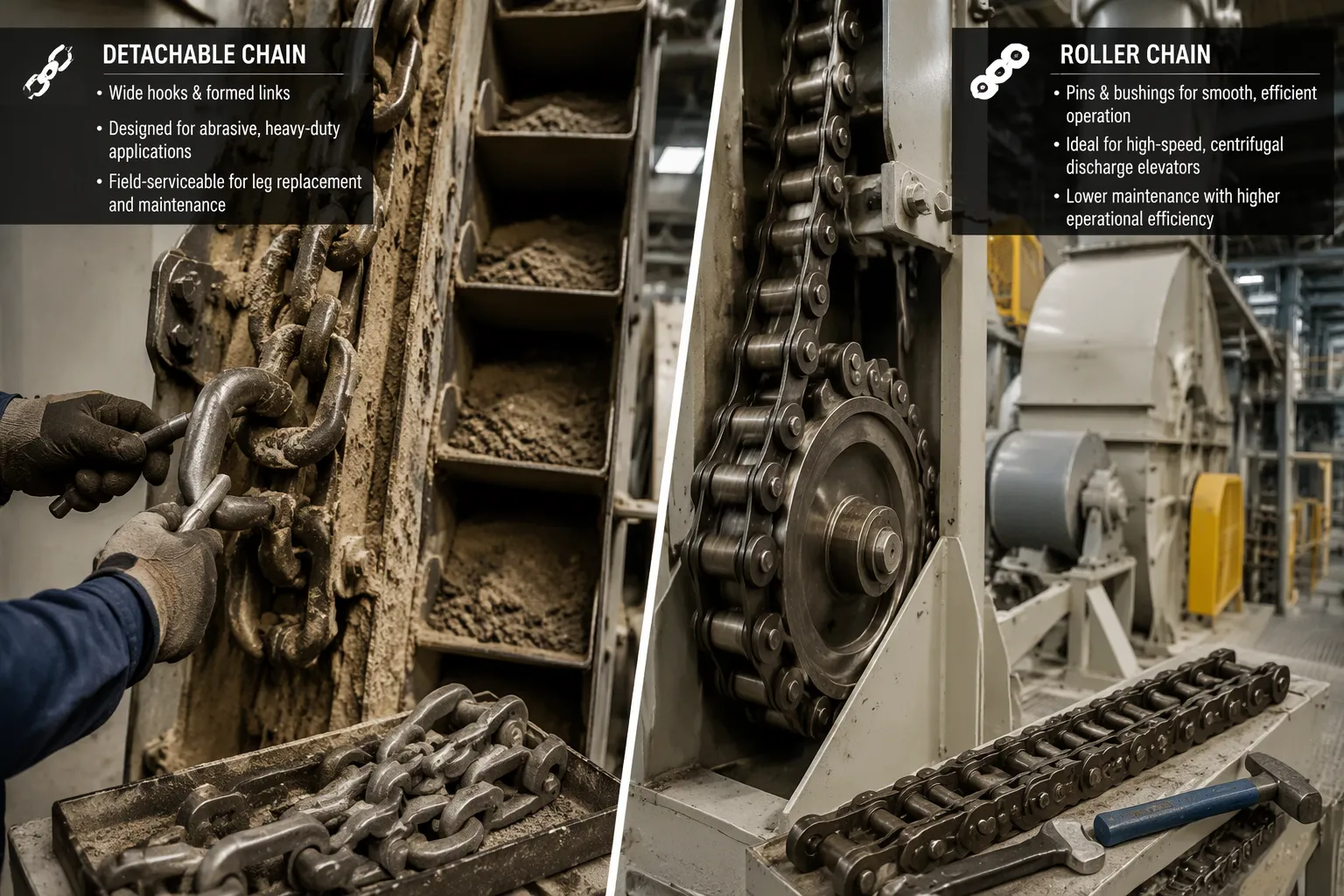
Illustrative field view of both designs in elevator service. Overlay wording is illustrative; the notes in the text below govern.
Where Steel Detachable Chains Fit Best
Heavy, Abrasive, or Hot Duties
Heavy duty work is a good match for the formed-link design, one of several conveyor chain types grouped by construction rather than by pitch. A steel detachable chain spreads tension across wide hooks. That shape stands up to the shock of a bucket biting into a pile of clinker or ore. Plants that move sand, cement clinker, foundry sand, or hot ash often choose this type. The links handle grit well, and heat-treated plates keep their strength in hot service. A steel chain in this class also handles the slow, loaded start that comes after a jam or a power outage. Teams that run an elevator chain through abrasive material should check hook wear on a set schedule. That one habit extends service life more than any other maintenance step.
Long Runs and Field Serviceability
Long center-to-center distances multiply chain weight and working load. A detachable design holds more capacity per unit of chain length. So a long run needs fewer strands for the same payload. Field service is the second advantage. Workers can open the chain at set points and replace a worn section without pulling the whole strand. Some designs allow a connection with only an impact driver. That speed matters on a tall elevator where every hour of downtime costs production. Maintenance crews at remote sites value this point most. They can carry a short spare section instead of a full replacement coil.
Where Roller Chains Fit Best
Higher-Speed and Smooth Operation
Centrifugal discharge elevators run fast, and speed rewards the rolling joint. A roller chain bends on pins and bushings. That rolling contact keeps friction low at higher chain speeds. The smooth engagement also cuts vibration at the head sprocket. Plants that need high throughput from a compact casing often choose this type. An engineered chain built to tight tolerances runs even smoother and quieter. Buyers should still confirm the published speed limit for the exact pitch and strand count. A chain drive pushed past that limit wears quickly, whatever its design.
Clean and Precision-Driven Systems
Clean, controlled settings suit roller chain well. Food plants, chemical lines, and packaged-goods systems need accurate bucket spacing and steady motion. A roller chain holds pitch precisely, and that precision keeps discharge timing consistent. These systems also tend to run indoors, away from rain and heavy grit. Stainless or coated options handle washdown duty. Precision matters most where a small timing error spoils the product or the batch.
Retrofit and Changeover Factors
Sprocket and Tooling Changeover
A chain swap rarely stops at the chain. Each type needs its own sprocket tooth profile. Detachable chain runs on sprockets shaped for hook engagement. Roller chain needs sprockets cut for pin-and-bushing seating. Engineered chain sprockets carry heavier teeth and cost more up front. A retrofit therefore pairs a new chain and sprocket set, and the budget should cover both, so a sprocket of the matching tooth profile belongs in the same order as the chain. Tooling changes too. Roller chain installation calls for pin presses and alignment tools. Detachable chain often needs only hand tools. Planners should schedule the changeover during a planned shutdown and stage the parts in advance.
When to Reassess Selection
Duty conditions drift over time. A plant may raise throughput, add a hotter product, or switch to a washdown routine. Any of these shifts can push an existing chain past its rated envelope. Engineers should revisit the choice when speed rises, when the material becomes more abrasive, or when repeated failures appear at the same point. Measured wear data gives the clearest signal. A chain that once lasted years and now fails in months is telling the plant something. At that point, a fresh review of elevator drive applications pays for itself. The key factors in industrial conveyor chain selection cover the checks such a review should follow, comparing both types against the new duty and confirming the pick with lifecycle cost.
Carbon Steel vs. Stainless Steel Roller Chains
Carbon Steel Roller Chains
Strength and Cost Profile
Carbon steel roller chains give you the most load capacity for your money. Heat-treated alloy plates and pins hold heavy tension without extra bulk. For the same pitch, you get more working load and a lower bill than with stainless steel. This makes them a good fit for most bucket elevator jobs in cement, mining, and grain work.
Corrosion Limits
Plain carbon steel starts to rust as soon as moisture touches the surface. Humid air, washdown spray, and coastal salt all make chains wear out faster. Surface treatments slow the rust, but they cannot stop it at a worn pin or a scratched plate. Plants in wet or chemical-heavy places should plan to inspect more often.
Stainless Steel Roller Chains
Corrosion and Temperature Range
Stainless steel roller chains fight rust and chemical damage much better than coated carbon steel. They last in food plants, chemical lines, and outdoor sites with lots of rain. Stainless also handles big temperature swings, but it holds less load at high heat than alloy steel does. Routine stainless steel roller chain maintenance protects that advantage, because the surface stays passive only while it stays clean.
Cost and Application Fit
Stainless steel chains cost a lot more per foot. That extra money only pays off when corrosion is the real reason chains fail. A clean, dry, indoor elevator seldom earns back the extra cost. Washdown, coastal, and chemical jobs usually do, and the durability of stainless steel roller chain in harsh environments is what repays the difference.
Choosing Between the Two
Matching Material to Environment
Picking the material comes after the bigger choice of detachable versus roller chain. First choose the chain design for load, speed, and duty. Then choose the material for the site. A wet plant that needs roller chain speed should go with stainless. A dry plant with the same speed can stay with carbon steel roller chains and save money.
Lifecycle Cost Considerations
Compare total cost, not just the price tag. Stainless steel roller chains win when corrosion causes repeat replacements. Carbon steel wins when the site stays dry and the work is heavy. Neither answer survives a change in duty, which is why the comparison belongs next to the operating record rather than in a catalog.
Choosing Between Alloy and Stainless Elevator Chain
Site conditions, washdown routine and operating temperature can be matched to the published material options for either chain family.
DONGCHUAN Elevator Chain Solutions
Changzhou DONGCHUAN, known as DCC, started in 2000. The company makes roller chains, sprockets, and conveyor chain solutions in a facility with more than 30,000 square meters of workshop space in Changzhou, Jiangsu Province, China. Its products serve mining, cement, grain processing, thermal power, and port transportation. DONGCHUAN holds ISO 9001 and API certifications, and it runs integrated quality control and EHS-compliant facilities. Buyers who need a dependable elevator chain manufacturer can compare the 55 series bucket elevator chain against their duty conditions.
Product Range and Customization
Configurations and Connection Options
The DONGCHUAN Industry Steel Forged Bucket Elevator Conveyor Roller Chain uses high-quality alloy steel, with optional stainless steel for corrosive sites. Buyers can order single, double, or multi-row configurations to match load capacity and operational demand. Connection options include rivet, spring clip, and threaded ends, so maintenance teams can pick the joint style that fits their service routine. Precision roller-chain plate integration reduces friction and keeps the strand stable under continuous high-load operation. The design also uses solid chain rollers and controlled tolerances to support smooth sprocket engagement.
Custom Pitch and Accessories
Customization covers pitch, inner width, and accessories. More than 40 percent of DONGCHUAN's annual production value comes from custom products with non-standard specifications, so custom work sits inside the normal production flow rather than outside it. A plant with an unusual casing or sprocket size can request a matched pitch instead of rebuilding the elevator around a stock chain. Accessories and attachment points follow the same order process. This flexibility helps when a retrofit must fit existing head and boot shafts.
Quality and Support
Certifications and Quality Control
Robotic welding gives uniform weld quality across every link. High-frequency heat treatment hardens the pins and plates that carry the working load. Corrosion-resistant surface treatments protect the steel in humid or chemically aggressive settings. These processes support minimum tensile strengths that run from 128 kN on the smallest NE size to 450 kN on NE300-250, with the NSE sizes in the same catalogue rated up to 1,470 kN, and the chain operates from -40°C to +300°C according to the published data. The ISO 9001 system covers process control, and the API certification adds tested performance for severe service. Buyers should still ask for material certificates and batch records with each shipment, as they would from any supplier.
Warranty and Global Service
DONGCHUAN backs this engineered chain with a warranty period of up to 24 months and support in more than 40 countries and regions, where it serves OEMs and industrial clients. Spare-parts planning benefits from this reach, because replacement sections can ship through established channels. A plant that runs an engineered chain in abrasive or hot duty should confirm stock terms and lead times at the order stage. The warranty covers the product; the maintenance plan still decides how long the chain lasts in service.
Five things decide whether steel detachable or roller chain is right for your bucket elevator:
How abrasive the material is and how hot it gets
The speed and working load you need
The environment, like dust, rust, and washdown
Rules you must follow
The total cost over the chain's whole life
First, match the chain type to how harsh the job is and how the elevator runs. Second, check that choice against the total cost over time. No single design suits every site, and a plant that follows this order avoids a costly mistake.
Readers who need a dependable elevator chain maker can contact DONGCHUAN for help with their specific job and product choices. Ask for a quote on custom pitch, strand count, or connection style.
Specify the Chain Against the Duty, Then the Budget
Duty conditions, casing size and sprocket details are enough to start a size check on either chain family.
FAQ
Which chain type suits most bucket elevator jobs?
No single type suits every job. Detachable chain works well for slow, heavy, abrasive, or hot duty. Roller chain works well for faster, cleaner, and precision-driven systems. Engineers should first match the design to how harsh the duty is. Then they should confirm the choice with lifecycle cost.
What signs show a chain needs replacement?
Worn chains stretch and no longer match sprocket pitch. Teams should check pin and bushing clearance on roller chain. They should check hook engagement depth on detachable chain. Fast wear at one point, rising noise, or repeated failures all mean replacement is due.
How do speed limits differ between the two types?
Roller chain usually runs faster because its pin and bushing joint rolls smoothly. Detachable chain fits lower speeds because its hook joint slides. Buyers should confirm the manufacturer's limit for the exact pitch and strand count before specifying.
Does a bucket elevator chain need lubrication?
Roller chain needs steady lubrication to protect pins and bushings. Detachable chain needs less at its hook joints. Both types still need periodic tension adjustment as they stretch. A plant without a lubrication route should weigh that labor against chain price.
What temperature range can these chains handle?
Standard carbon steel loses strength as heat rises. DONGCHUAN's forged bucket elevator roller chain is published for -40°C to +300°C, depending on model and material. Buyers should confirm the rated range for their specific hot or cold duty before ordering.
When does stainless steel make sense over carbon steel?
Stainless steel pays off when corrosion causes repeat failures, such as washdown, coastal, or chemical service. Carbon steel wins in dry, heavy-duty work where load capacity and lower price matter most. Material choice comes after the chain design decision.
What changes during a retrofit?
Each chain type needs its own sprocket tooth profile. So a swap pairs a new chain with a new sprocket set. Tooling changes too. Planners should schedule the changeover during a planned shutdown and stage parts in advance.
How long does replacement chain take to arrive?
Lead time varies by pitch, strand count, and stock status. Specialty chain can idle an elevator for weeks if unavailable. Buyers should confirm stock terms and shipping before committing. DONGCHUAN backs its chain with a warranty of up to 24 months and support in more than 40 countries.
References and Notes
Dimensional standard for agricultural, detachable and pintle chain — definition of steel detachable link chain (end bars articulate inside the hook) and the consolidation of the older detachable chain standard (asme.org, accessed 2026-11-16)
Workplace safety rules for grain handling facilities — guarding, inspection access and ignition-source control in bucket elevator legs (osha.gov, accessed 2026-11-16)
Combustible dust standard for agricultural and food processing facilities — housekeeping, venting and ignition-source rules referenced in the dust hazard section (nfpa.org, accessed 2026-11-16)
Data notes: tensile values (128 kN to 450 kN on the NE and NP sizes, up to 1,470 kN on the NSE sizes) and the -40°C to +300°C range are model-specific figures published by the manufacturer, not industry-wide ranges. The 40 percent custom-work share and the warranty period of up to 24 months are company statements. Figures that could not be traced to a published source were removed in this rewrite.
Illustration note: the product comparison drawings are renderings, and the overlay wording on the application figure is illustrative; the technical statements in the text take precedence.
Internal links: all original links to dcchains.com are preserved, with anchor text matched to each landing page.

