


Apron Conveyor Chain Pitch, Attachments & Customization: An Engineer's Guide
Apron conveyor chain pitch is the critical distance between pin centers. This dimension determines strength, operating speed, and sprocket compatibility. Attachments add specific functions such as scraping or lifting. Customization tailors materials and geometry to extreme environments. The core question: How does an engineer select the right combination? Selection depends on load, speed, material type, and operating environment. This guide explores standard sizes, common attachments, and custom options. It uses examples from a leading manufacturer to demonstrate best practices. Engineers can apply these principles directly.
Key Takeaways
Pitch is the distance between pin centers. It determines chain strength, speed, and sprocket fit.
Larger pitch increases strength but adds weight and cost. Choose the smallest pitch that meets load requirements.
Attachments like A1, A2, K1, K2, L-shaped, and G-type add functions such as scraping, lifting, or pushing.
Select attachments based on material type and required function. Consider weight, power, and wear.
Customize chains with materials like carbon steel, stainless steel 304/316, or hardened alloys for extreme conditions.
Coatings like zinc, epoxy, and nickel extend chain life in moderate environments.
For high heat up to 500–600°F, use forged plates in large pitches. They resist thermal distortion.
Follow a step-by-step process: define load, speed, and environment; choose pitch; select attachments; specify customization.
Partner with experienced manufacturers like DCC for custom engineering and quality certifications like ISO 9001 and API.
Apron Conveyor Chain Pitch Explained
Definition and Standard Sizes
What is pitch? (distance between pin centers)
Pitch is the distance from the center of one pin to the center of the next pin on a chain. This single measurement defines the chain's geometry and serves as the foundation for every downstream design decision. An engineer measures pitch by taking a sample of the existing chain and measuring from pin center to pin center. The result is the pitch value. This dimension controls how the chain meshes with sprockets, how much load it can carry, and how fast it can run.
Common standard pitches (e.g., 4", 6", 9"; metric equivalents)
Standard pitches vary by chain type and application[1]. Common apron conveyor chain pitches include 1.664" (662 pintle chain), 2.250" (667X pintle chain), 2.609" (88C pintle chain), 2.313" (67H steel detachable chain), and 2.906" (S steel detachable chain). Larger industrial apron conveyors often use pitches of 4", 6", or 9" and their metric equivalents. Non-standard pitches are also possible. Manufacturers can adapt apron conveyor chains to most pitch sizes, which gives engineers flexibility when standard options do not fit.
One design detail deserves attention early. Pan bottoms sit above the chain pitch centerline. This offset affects material containment. Engineers should account for it during the design phase to prevent spillage and ensure proper pan alignment.
Pitch, Strength, and Speed
Relationship between pitch and tensile strength
A larger pitch generally allows a heavier chain construction. The increased distance between pins permits thicker plates, larger pins, and stronger sidebars. These elements raise tensile strength. A smaller pitch limits the cross-sectional area available for load-bearing components. Engineers who need higher capacity therefore tend to select a larger pitch. The trade-off is added weight and higher material cost.
Impact on operating speed and sprocket selection
Pitch directly affects operating speed. A chain with a large pitch travels farther per sprocket revolution. This relationship means the same sprocket RPM produces higher linear speed on a large-pitch chain. However, large-pitch chains generate more chordal action, which is the vertical rise and fall of the chain as it wraps around the sprocket. This motion increases vibration and wear at higher speeds. Sprocket selection must match the chain pitch exactly. A mismatched sprocket causes rapid wear, noise, and potential chain failure. Engineers should confirm sprocket availability before finalizing a pitch choice.
Selection Guidelines
Load requirements (static and dynamic)
Static load includes the weight of the chain, pans, and material at rest. Dynamic load adds the forces from acceleration, impact during loading, and shock from uneven material distribution. Engineers must calculate both. A chain sized only for static load will fail prematurely under dynamic conditions. For heavy loads and high capacities, larger pitch sizes above 8 inches are typically used. The engineer should verify that the selected pitch provides an adequate safety margin above the calculated peak load.
Conveyor length and drive configuration
Conveyor length influences pitch selection through chain weight and friction. A long conveyor accumulates more chain weight, which raises the required pulling force. The drive configuration also matters. A single-end drive suits shorter conveyors. Longer systems may need multiple drive points or a return-run drive to distribute tension. The engineer should match the pitch to the drive sprocket size and the available torque. A pitch that is too small for the drive configuration will limit throughput. A pitch that is too large will add unnecessary cost and weight. Engineers should document load, speed, and environment before selecting a pitch. This step prevents costly redesigns later.
Attachments for Apron Conveyor Chains
Standard Attachment Types
A1/A2 and K1/K2 attachments
A1 and A2 attachments are the most common configurations for apron conveyor chains. The A1 style extends on one side of the chain, while the A2 style extends on both sides. These attachments allow engineers to bolt pans, slats, or crossbars directly to the chain. K1 and K2 attachments follow a similar pattern but feature a different hole pattern and mounting orientation. The K-style attachments work well when the pan must sit flush against the chain. Engineers select between A and K styles based on the pan mounting method and the clearance available in the conveyor frame.
L-shaped links for slat mounting
L-shaped chain links serve as custom attachments for mounting slats. The vertical leg of the L provides a flat surface for bolting wooden or steel slats. This design allows the slat to sit perpendicular to the chain travel direction. Engineers use L-shaped links when they need to build a continuous conveying surface from individual slats. The L-shape also adds rigidity to the chain assembly, which helps maintain alignment on long conveyors.
G-type attachments for deep-bucket pans
G-type attachments allow mounting of deep-bucket pans. These attachments feature a taller profile than standard A or K styles. The extra height provides clearance for the bucket pan to sit below the chain centerline. Engineers choose G-type attachments for vertical or steep-incline conveyors that lift material in buckets. The attachment geometry must match the bucket mounting pattern exactly to prevent stress concentrations at the bolt holes.
Performance Considerations
Added weight, power consumption, and wear
Every attachment adds weight to the chain assembly. This added weight increases the required pulling force and the power consumption of the drive motor. The attachment also creates a stress concentration at the point where it joins the chain link. Engineers should verify that the chain's tensile strength accounts for both the attachment weight and the material load. Wear accelerates at the attachment holes and at the pin-bushing interface. Regular inspection of these points prevents unexpected downtime.
Lubrication and compatibility with pans
Attachments change the lubrication path along the chain. A large attachment can block lubricant from reaching the pin and bushing. Engineers must specify a lubrication method that reaches all wear points. The attachment material must also match the pan material to avoid galvanic corrosion. For example, a stainless steel pan requires stainless steel attachments. The heavy-duty steel apron conveyor chain from DCC uses overlapping fish-scale plates to minimize leakage. This design demonstrates how attachment integration can solve a real material containment problem.
Selection Criteria
Material type (bulk, sticky, abrasive)
The material type drives attachment selection. Bulk materials like gravel and sand need simple A-style attachments with flat pans. Sticky materials require pans with smooth surfaces and minimal gaps. Abrasive materials like limestone and granite demand hardened attachment surfaces. Engineers should match the attachment hardness to the material abrasiveness. A softer attachment will wear quickly and require frequent replacement.
Required function (scraping, lifting, pushing)
The required function determines the attachment geometry. Lifting and loading materials calls for buckets, forks, or similar designs that can bear sufficient weight. Scraping and pushing require a cutting edge. Steel edges work well for challenging conditions and a consistently clean surface. Poly edges suit applications where no marks should be left. Rubber edges prevent surface damage and reduce noise. Engineers can also specify interchangeable steel, poly, or rubber edges when conditions change. This flexibility extends the attachment's service life across different operating scenarios.
Apron Conveyor Chain Customization
Standard chains handle many applications. Extreme temperatures, abrasive materials, and strict hygiene rules demand more. Customization bridges that gap. Engineers can tailor materials, coatings, and geometry to match exact operating conditions.
Material and Coating Options
Carbon steel, stainless steel (304/316), hardened alloys
Material choice shapes every performance trade-off. Carbon steel offers high load capacity and excellent wear resistance. Its hard pins, bushings, plates, and rollers resist abrasion well. Carbon steel also resists elongation under stress. These traits suit heavy-duty drives in dry, indoor settings. The material costs less than stainless steel. However, carbon steel corrodes without coatings or lubrication. It performs best in mining, cement production, and construction materials handling.
Stainless steel 304 and 316 serve different needs. Grade 316 contains 2–3% molybdenum[2]. This addition dramatically improves resistance to chloride-induced pitting and crevice corrosion. Engineers specify 316 over 304 when the process involves bleach, seawater, salt brine, seafood, dairy, fermented foods, coastal plant locations, or phosphoric, formic, and acetic acid contact. The low-carbon variant 316L keeps carbon at or below 0.03%. This limit minimizes sensitization during welding. Grade 316 typically costs more than 304 for equivalent specifications. In low-chloride environments with well-controlled cleaning agents, 304 performs identically to 316. The premium is not justified there. When chloride attack occurs, the cost of unplanned replacement — including production downtime, cleaning, and change-over labor — almost always exceeds the original cost premium of specifying 316 from the start.
Stainless steel carries a lower working load than carbon steel. It also wears faster under load and elongates more quickly. Engineers who switch from carbon to stainless steel at the same pitch and width must reduce the design load. Running stainless at the original carbon steel load eliminates the safety margin and accelerates failure. Hardened alloys fill the gap between these two families. Heat-treatable grades deliver maximum hardness for abrasive service. They resist wear without the corrosion penalty of stainless steel.
Zinc-plating, epoxy, and nickel coatings
Coatings extend carbon steel life in moderate environments. Zinc-plating provides sacrificial protection against rust. Epoxy creates a barrier against chemicals and moisture. Nickel coatings add hardness and corrosion resistance for demanding duty. Each coating adds cost and requires careful handling during installation to avoid damage.
Design Modifications
Extended pins and outboard rollers for heavy loads
Extended pins move the load path outside the chain link. Outboard rollers ride on separate tracks. This design isolates the chain from heavy vertical loads. The chain pulls. The rollers carry. This split reduces pin and bushing stress. Engineers specify this configuration for massive bulk loads and long conveyors.
Custom pan profiles and leak-proof pans
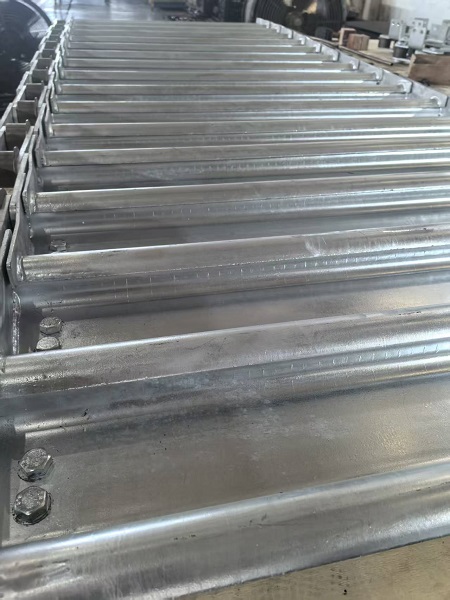
Pan geometry controls material containment. Overlapping fish-scale plates create a continuous metallic trough. This design minimizes leakage for bulk particles and metal scraps. Engineers can specify pan widths from 6 inches to over 96 inches. Custom profiles match the material flow pattern and prevent spillage at transfer points.
Large-pitch forged plates for high heat (500–600°F)
High-temperature applications demand special construction. Forged plates in large pitches withstand up to 500–600°F[3]. This capability suits hot castings, sand boxes, sinter, coke, and steel slag. The forged structure resists thermal distortion. It maintains chain integrity when standard materials would soften or warp.
Industry-Specific Examples
Food processing (hygienic stainless steel)
Food processing requires easy cleaning and corrosion resistance. Stainless steel 304 or 316 serves this need. The material prevents crumb leakage and handles washdown procedures. Engineers specify smooth pan surfaces and minimal gaps. These features stop bacterial growth and simplify sanitation.
Mining (abrasion-resistant steel, >8-inch pitch)
Mining conveys large, sharp-edged stones like limestone and granite. Abrasion-resistant steel prevents belt tearing. Pitches above 8 inches provide the strength and capacity for heavy ores. The larger pitch also tolerates the impact of uneven loading.
Foundry and waste disposal (heat-treated, corrosion-resistant)
Foundries handle hot castings and abrasive sand. Waste disposal manages scrap metal and construction waste. Heat-treated chains resist thermal stress. Corrosion-resistant grades handle moisture and chemicals in waste streams. These combined properties keep operations running without frequent chain replacement.
DCC's heavy-duty steel apron conveyor chain demonstrates these principles. The product withstands 500–600°F and comes in custom widths from 6 inches to over 96 inches. Over 40% of DCC production is custom-made. The company exports to 40+ countries. This record shows strong engineering support for unique requirements. Engineers who need a tailored apron conveyor chain can rely on manufacturers with this depth of experience.
Selecting the Right Apron Conveyor Chain
Step-by-Step Decision Process
Define load, speed, and environmental conditions
Engineers start by documenting the material weight per hour, the chain speed, and the operating temperature. They also note exposure to abrasion, corrosion, and moisture. These inputs form the basis for every later choice.
Choose pitch based on load and sprocket limitations
Heavier loads and higher capacities usually call for larger pitches above 8 inches. The engineer must confirm that sprockets in the required size remain available. A pitch that fits the load but lacks a matching sprocket will stall the project.
Select attachments for material handling function
The material type and the required motion guide attachment selection. Lifting duties call for bucket-style attachments. Scraping duties call for edge plates. The engineer matches the attachment to the task.
Specify customization needs (material, coating, pan profile)
Carbon steel suits dry, abrasive service. Stainless steel 304 or 316 suits hygienic or corrosive settings. Coatings extend life in moderate environments. Pan width and profile follow the material flow pattern.
Common Pitfalls
Oversizing pitch, leading to unnecessary cost
A larger pitch adds weight, cost, and sprocket size. Engineers who oversize without justification pay more for capacity they never use. The correct approach sizes the pitch to the calculated peak load with a reasonable margin.
Ignoring attachment interference with conveyor structure
Attachments can collide with side guards or frame members. Designers avoid this problem through curved or contoured mounting surfaces that follow the conveyor side guard geometry. A through-hole attachment method also helps. It secures the mounting device without extra bracketry and without blocking material movement.
| Design Approach | How It Avoids Attachment Interference |
|---|---|
| Curved/contoured mounting surfaces | Follows side guard geometry, avoiding sharp edges or protrusions |
| Through-hole attachment method | Secures devices without bracketry or obstructions |
Underestimating wear from temperature and abrasion
High heat softens standard materials. Abrasive loads grind away pin and bushing surfaces. Engineers who ignore these factors face short chain life and frequent replacement.
Partnering with a Manufacturer
Providing accurate specifications and application details
A manufacturer needs the chain pitch, tray width, material grade, and any OEM equipment details. Useful inputs include equipment make and model, load size and material, frequency of use, and desired lifespan. Key dimensions include approximate pitch, sidebar thickness, sidebar height, and pin diameter.
Leveraging custom engineering for non-standard needs
DCC, with over 20 years of experience, assists in prototyping and engineering support for custom designs. Over 40% of its production is custom-made.
Verifying quality certifications (ISO9001, API)
ISO 9001 confirms a documented quality management system. API rules confirm that drive parts pass demanding field tests. Certified suppliers provide tested load ratings and long-term safety for heavy machinery. Buyers should request proof of these certifications before placing an order for any apron conveyor chain[4].
Pitch sets the strength and speed of an apron conveyor chain. Attachments add the function the application needs, whether that means scraping, lifting, or pushing. Customization then tailors materials and geometry to extreme heat, abrasion, or corrosion. The decision checklist stays simple. Engineers define the load and environment first. They select pitch and attachments next. They finish by specifying material, coating, and pan profile. Complex applications often need more than a catalog part. A manufacturer with deep engineering experience, such as DCC, can prototype and support custom designs. That partnership protects reliability and performance over the long run.
Need a Custom Apron Conveyor Chain?
DCC supplies apron conveyor chains with standard and custom pitches, attachments, and materials, backed by ISO 9001 and API quality systems and 20+ years of engineering support.
Explore Our Chain RangeSend Us an InquiryFAQ
What is apron conveyor chain pitch?
Pitch is the distance from one pin center to the next pin center. This measurement controls chain strength, speed, and sprocket fit. Engineers measure it on a sample chain to confirm the correct value before ordering a replacement.
Which pitch sizes are standard for apron conveyors?
Common pitches include 1.664", 2.250", 2.609", 2.313", and 2.906" for pintle and detachable chains. Larger industrial apron conveyors often use 4", 6", or 9" pitches. Manufacturers can also adapt chains to non-standard pitch sizes when needed.
How does pitch affect chain strength and speed?
A larger pitch allows thicker plates, larger pins, and stronger sidebars. These features raise tensile strength. A large pitch also moves the chain farther per sprocket revolution, which increases linear speed but adds more chordal action and vibration.
What are A1, A2, K1, and K2 attachments?
A1 and A2 attachments extend on one or both sides of the chain. K1 and K2 attachments use a different hole pattern and mounting orientation. Engineers choose between A and K styles based on pan mounting method and available clearance in the conveyor frame.
When should an engineer choose stainless steel over carbon steel?
Stainless steel 304 or 316 suits hygienic or corrosive settings, such as food processing and coastal plants. Grade 316 resists chloride pitting better than 304. Carbon steel offers higher load capacity and wear resistance in dry, abrasive service.
Can manufacturers customize apron conveyor chains for high heat?
Yes. Forged plates in large pitches withstand up to 500–600°F. This construction resists thermal distortion in hot castings, sand boxes, sinter, coke, and steel slag service. Standard materials would soften or warp at these temperatures.
What is the maximum width for a custom apron conveyor chain?
Manufacturers can specify pan widths from 6 inches to over 96 inches. Custom pan profiles match the material flow pattern and prevent spillage at transfer points.
Which certifications should a buyer verify before ordering?
Buyers should confirm ISO 9001 quality management certification and API compliance. Certified suppliers provide tested load ratings and long-term safety for heavy machinery. Request proof of these certifications before placing an order.
References
ASME B29.300 — Agricultural, Detachable, and Pintle Chains, Attachments, and Sprockets. https://www.asme.org/codes-standards/find-codes-standards/b29-300-agricultural-detachable-pintle-chains-attachments-sprockets
International Stainless Steel Forum — Stainless Steel Grades and Properties. https://www.worldstainless.org
British Stainless Steel Association — High-Temperature Performance of Stainless Steels. https://bssa.org.uk
International Accreditation Forum — Management System Certification. https://www.iaf.nu

